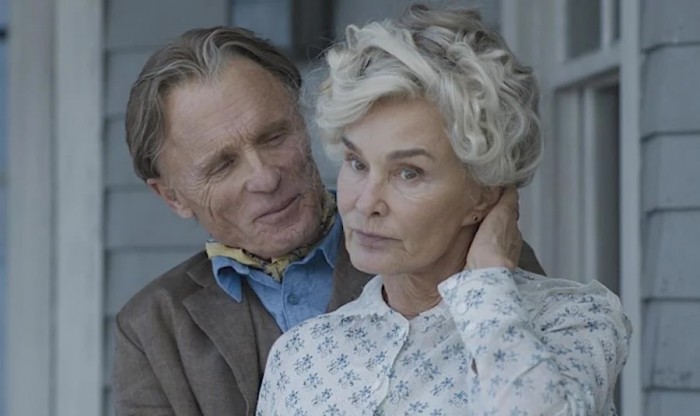
ED HARRIS, JESSICA LANGE IN A LONG DAY'S JOURNEY INTO NIGHT
Eugene O'Neill: family dysfunction maximized
The play this film is a condensation of (it's just under two hours; play productions can run to four) is an intensely autobiographical depiction of the young life of Eugene O'Neill, the greatest and most influential American playwright of the first half of the 20th century. Because of its intimacy, O'Neill wanted it, written in1939-40, to be held 25 years from his death. But his widow allowed it to come out only three years later, in 1956. It is powerful stuff. But as can happen, it has been so influential, and its over-and-overing of family neuroses so common in the decades after its production, it and its approach so naturalistic (despite O'Neill's aspirations to Greek tragedy) you may be more charged by more innovative later 20th-century drama, like Pinter or Beckett.
Your neurotic family or neurotic relationship is here, front and center. You may be lucky enough to know nothing personally of such things. Not all of us can say that. All of us must admit we know dysfunction exists all around us, like other problems. Here at the center is the wife and mother, Mary Tyrone (Jessica Lange - and she is the prima donna, the center of the drama). Beside her is her husband of many years, James Tyrone (Ed Harris), once highly successful as an actor, perhaps not for very long, and not now. Having not seen Lange or Harris for a while, I was shocked at how old they look. But their looks are decayed grandeur, crumbling beauty. Lange costarred with others in two major stage productions of the play, 2000 in London, 2016 in New York, winning awards each time.
Coming from an impoverished Irish family, James is now a skinflint, affaid of squandering the money he now has. The late 19th-century house they occupy (actually a set built and shot in Eire, County Wicklow) is closely based on the O'Neill family's original Connecticut summer house. It looks comfortable enough, but Mary complains it was shoddily built to satisfy James's penny-pinching.
What are they doing? Talking, mainly. It's a play. But Mary is recently out of rehab, for a morphine addiction whose origin goes back decades, apparently to the birth of youngest son Edmund Tyrone (Colin Morgan), who represents the playwright. Sadly, he and his father and his older brother Jamie (Ben Foster) all know Mary has gone back to using. We are further saddened to realize that the three men in the family are all drinkers, quaffing whisky at every opportunity, their Irish background rampant.
They, or the play, will have to find a way to forgive Mary, to accept that if she is a "dope fiend," it is really not her fault but an evil curse that has befallen her. It would be better still to say it is a disease, but that wouldn't be so grand and tragic or express O'Neill's understanding when he wrote the play.
Edmund is going to see a doctor and it's suspected that his "summer cold" isn't that, but "consumption" - tuberculosis. He gets the result. The shocker is how the self-absorption and family conflict dominating the conversation makes this get lost: all gets swirled and swept under in a maelstrom of dysfunction, even though they love each other. But Jamie's - Edmund's older brother's - major speech is one in which he warns Edmund never to trust him; love is not support. Mary, the mother, drifts into an Ophelia moment, noted as such. What about the father, James? His loving-kindness is sincere, but drunken and ineffectual. The play doesn't tell us what happened to the young man, O'Neill's alter ego, who must go to a treatment center: but we know he went on to become a great playwright.
The film is admirable for its austerity. Its powerful, clear language is enough to carry us through. In his debut as a film director, Jonathan Kent, who helmed the 2016 Broadway production of the play, has opened it up by taking the men outside a little, but doesn't violate the stage conception of the action, or even added any music, letting the words sing for themselves. In his New York Times 2016 review of the Broadway production, Ben Brantley didn't think the cast felt like members of the same family. I was disturbed, rather than moved, but found no such fault. Maybe there could have been a symphony and there is only a set of solos. But if this isn't a great production, it's a fine adaptation. I admired Jessica Lange, including the Victorian disarray of her gray hair (an Oscar makeup nom?). O'Neill is someone we all need to know more about, and this is a beginning. We must go on to see Sidney Lumet's 1962 film adaptation, with Katharine Hepburn, Jason Robards, Ralph Richardson, and Dean Stockwell. We must go back to other importat O'Neill plays adapted to film, to Anna Christie, The Emperor Jones, Ah, Wilderness!, and many more, starting in the 1930's. Welcome to Eugene O'Neill, a writer so great he seems familiar already.
A Long Day's Journey into Night, 109 mins., premiered Feb. 7, 2025, Dublin. The film was released in theater through Quiver Distribution starting Oct. 16, 2026, with prior limited screenings at Lincoln Center in New York.