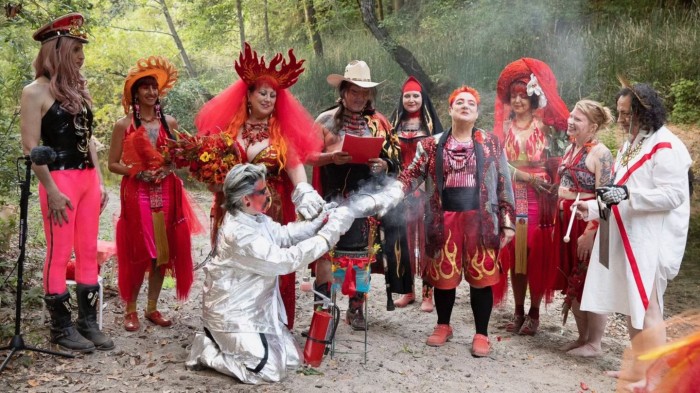
A SCENE FROM PLAYING WITH FIRE
ANNIE SPRINKLE, BETH STEPHENS: PLAYING WITH FIRE: AN ECOSEXUAL EMERGENCY (2025)
A look at the near-destruction by fire of a Santa Cruz mountain town
This is a film that looks at the explosion of forest fire in California through the eyes of the pair who directed it, whose home town was badly damaged by wildfire in 2020. Queer married couple, life partners, and collaborative multimedia art duo Annie Sprinkle and Beth Stephens, or Sprinkle Stephens, are founders of the international ecosex movement. Sprinkle, now 72, was a sex worker, pornographic actress, and sex-positive activist from 1973 until 1995. Since then she has become a feminist performance artist, author, and sex educator, earning a Ph.D. in human sexuality. Beth Stephens, who is 66, is an artist, filmmaker, sculptor, and teacher, who became an art professor at the University of California Santa Cruz in 1994, where she directs the E.A.R.T.H. Lab, a collaborative center that produces experimental environmental art and performance projects focusing on ecology, social justice, and ecosexuality.
The pair began collaborating on art and life projects together in 2002 and married. In 2008 they launched the ecosex movement with their "Ecosex Manifesto" and symbolic weddings marrying the Earth. They use an "ecosexual lens" to view the Earth as a lover, blending environmentalism with humor, art, and queer ecology.
This is Sprinkle Stephens' third documentary feature, following Goodbye Gauley Mountain: An Ecosexual Love Story(2014), their first feature documentary, which investigates and protests destructive mountaintop removal coal mining in West Virginia, and Water Makes Us Wet: An Ecosexual Adventure (2019), their second, which explores human relationships with water, water conservation, and sustainability.
Boulder Creek, California serves as the directors' home and the central setting of Playing with Fire affected by the 2020 CZU Lightning Complex fires. The film begins with Sprinkle and Stephens talking about how charming this town of 5,000 is and how much they love it. Bordering on Highway 9, it has the features of a 19th-century boomtown with Old West-style architecture that makes the area feel like a step back in time, or a movie set. It is also the gateway to Big Basin Redwoods State Park. Though it has only a handful of restaurants they say it has all they need. They also talk about and feature a long-lived white peacock nicknamed Albert that they call the "mayor" of the town. Other town citizens of the human variety provide supporting comments.
Then comes the fire, the evacuations, and the destruction. They describe Albert as crying and warding off the fire, or trying to, and show him apparently doing so. The film here blends personal loss with humor and community care, weaving together stories from Indigenous scholars, formerly incarcerated firefighters, neighbors, and fire artists. The intention is to show how artists respond to eco-emergency practically and artistically.
Brandon Smith is the co-founder of the Forestry and Fire Recruitment Program (FFRP), an organization dedicated to helping other formerly incarcerated individuals transition into professional wildland firefighting careers. In the film, Smith provides an extensive interview highlighting his own experience and the history, challenges, and exploitation surrounding incarcerated labor on the firelines. This has been spoken of before, but is perhaps the most important topic in the film.
Playing with Fire for newcomers to the idea of the "ecosexual" may seem mostly an exploration of wildfire from the point of view of the California mountain coastline tie-dye T-shirt set, and for whatever it adds to Sparkle Stephens' film trilogy it adds a serious local and a more personal note than mountaintop coal mining or water conservation. Over the past decade (roughly 2016 to 2025), wildfires have burned over 12 to 13 million acres across California, which is more than 12%—or roughly 1 out of every 8 acres—of the entire state's land area. The filmmakers' house was saved, but others in the Santa Cruz County area 700-900 homes were destroyed and 97% of the Big Basin State redwoods were burned. The couple eventually visit the park (they can't bear to at first) and while it is like a standing graveyard, they are pleased to find that one of the oldest, 1,00-year-old trees survived, which they examine, hug, and declare "well-hung and sexy."
So here we have another look at the crucial issue of eco-destruction from climate change from a local, Santa Cruze Mountains of California point of view and with an artistic, partly lighthearted angle. There is much here about a local artistic community and their responses to fire as a force both creative and destructive. Some of the scenes and costumes are very colorful. But this may be more valuable as an insight into the Sparkle Stephens collaboration than the topic. For a more in depth documentary about recent wildfire destruction of a small California town you need go no further than Ron Howard's impressive Rebuilding Paradise (2020), which covers all aspects of the near-total destruction and painstaking beginnings of restoration of the Sacramento Valley town of Paradise, California, including vivid coverage of the fire and the evacuation drawn partly from locals' amateur footage. As a documentary subject, this is a challenging one, and it takes someone with the skills and resources of a Ron Howard to do it justice.
Playing with Fire: An Ecosexual Emergency, 71 mins., premiered June 20, 2025 at Frameline 49, the San Francisco International LGBTQ+ Film Festival. It will have a limited rollout in theaters Sept. 26, 2026, and will be available on digital platforms in the US and Canada starting Nov. 6.