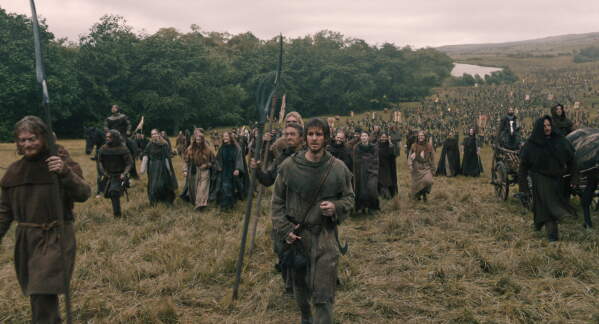
ANDREW GARFIELD (CNTER) IN THE UPRISING
All that violent history and then he puts on a hood at the end
Huizinga's The Waning of the Middle Ages famously opens with "the violent tenor of life" of that period, the 14th and 15th centuries, which he describes as a time of stark, violent contrasts between extreme suffering and intense joy when everyday existence involved cruel punishments, public beheadings, and raw passions balanced against a longing for a refined, gentle courtly life. Sounds like one of the kinds of movies or stories I relished when I was a boy - and still good material for a movie. Even if this isn't one of the best movies of the year, it's fun and entertaining, by the souped-up standards of the day.
So this is what Paul Greengrass' The Uprising gets down to, and the when is 1381 England during the historical Peasants' Revolt against King Richard II led by, or experienced through, Andrew Garfield, known here as Ploughman. Using his handheld documentary style fluently (they had no Steadicam, you see, in the fourteenth century) the director gives us mostly the nearly wordless violence, and is short, like down to nothing, on the refined courtly life, though the teenage king (a very cool Woody Norman) is a sort of vision of godlike power and glamor for the peasants that their leaders get to see, as do we. For the lowest, this is what Divine Right means: the ruler is almost a god. To start with, by the way, half England's population has been wiped out by Plague. Ploughman has lost his wife and two daughters. He is haunted by fantastic visions of the dead, as it turns out are others, even very high up. There is misery around the corner for everyone, high and low. That's what "violent tenor of life" means.
Leaders, plural, because there are crowds around Ploughman, himself an everyman figure invented for the film. The movie isn't historically accurate, but this is good stuff, even if things get a bit blurry in places. There are other leaders in the mobs where Ploughman shines. Other members of this excellent cast may be hard to pick out. Tom Hollander is Sir Robert Hales, the royal treasurer; Stephen Dillane is Archbishop Sudbury. Two other key ones are the peasant leader Wat Tyler (Cosmo Jarvis) and the rebel priest John Ball (Jamie Bell).
As depicted here, the 14-year-old king has not proven himself a king. The governing is being done by a Counsel of wealthy men. The Hundred Years War is on, and the Kingdom needs money to fight the French and Spanish. The revolt is stirred up when heavy poll taxes are laid on the peasants to avoid giving the merchant class a voice or the Church more of one, as the Counsel would have to if those factions were heavily taxed.
For all the noise and chaos, the film has sequences of splendid theatricality. Ploughman's explosion of rage at the polls, when young woman are getting simultaneously physically abused to find if they're of age (have pubic hair, apparently), and so can be taxed, is a good establishing moment. But more thrilling is the moment when young King Richard, who has been on his knees praying and downcast and obedient to the Counsel, suddenly speaks out, asserting authority with a stunning finger snap. Woody Norman has dramatic hair (just like the painting of the real king) and a strong, raucous voice at odds with his pure face. The boy declares that he's going to be king, will meet in the field with the rebels, and orders the Counsel members to stay at home. The several meetings are all out of doors, with Bavarian medieval towns and landscapes standing in for fourteenth-century England and cathedrals showing the reach of architectural art at this time.
Read no further if you want to be surprised by the outcome after the King meets with the peasants. Or do read to help you follow what may get a bit confusing amid all the excitement and Greengrass dp regular Pål Ulvik Rokseth's kinetic images. Historically Richard II may have been a bit weird but not crazy, it's thought now. Maybe he merely reads as boyish panache at this point. Anyway it's all there in Woody Norman's voice and vivid facial expressions.
When Richard rides out to meet the rebelling peasants he astonishes by proclaiming that he accepts their petitions and says that, as they demand, their rent will be fixed, taxes lowered, and farming as serfs discontinued. Then he announces he will meet with the leaders at Smithfield, but that becomes a trap. Hemmed in, the rebels are massacred by a combine of various private armies. It is another visual coup to see them cut down by arrows from above.
Katherine Waterston is superbly restrained and queenly as the royal mother, Joan of Kent, and the writing of her part gives some structure to the action. Joan at first is pleased at the boy's apparent nobility of spirit and sacrifice, then at the next stage when he betrays the rebels, she frowns with shock and disappointment. All this is done effectively without dialogue. She balances our impression that Richard is madly cruel but astonishingly deft ,enough to make it seem justified that he reigned for another 18 years before being deposed.
The other stars are the costumes, the impressively homespun, heavy, much-mended peasants' clothing, the armor, and the royal headdresses. Norman has said how painful it was to wear a crown but he wears it memorably as he does the dazzling ermine cloak and armor with its special crown. Don't remember as you look at him draped in fur that the actor's been meatless since the age of ten. It's only synthetic, of course.
Greengrass gives us a sense of how exhausting all this is for the rebels, who seem to be running around for days without sleep. The young king orders the parched rebel leader Wat Tyle to be given a cup of ale - not enough! But like a lot here, it's good as theater. So is the use of fire several times, memorably toward the end three large baskets of scrolls, granting freedom, ("manumission") one supposes, ceremonially set fire to one after another. Sadly, because a tall but lowly young scribe (Sky Yang) has worked so hard getting them drawn up, supervising a whole team of under-scribes. As a scribe myself, I sympathized.
Ploughman doesn't read, but he gets to have a heart-to-heart talk with the young king. Perhaps implausible, but one thing the movie does well is develop that relationship between peon and prince from phantom to feel-good, slowly modulating it as a magic moment we're with every halting step of the way. Too bad a lot of this may not be true, but the better to make us run to the history books to find out just what did happen.
One of the ways this intense, enjoyable version of history falls a bit short of a home run is the Robin Hood issue. It seems the distributors in the UK vs. those in the US didn't agree on whether this was a straight historical film or a sort of prequel with Ploughman leading the surviving rebels into the forest so Andrew Garfield can be the star of a series of new Robin Hood screen tales. (Wrong King Richard, by the way.) The US guys threw that in at the last minute; the UK boys weren't interested. This muddies the final segment of The Uprising. Chang in The New Yorker calls this iteration of Greengrass historical action "scattershot." But I was never bored.
The Uprising, 127 mins., released Sept. 11, 2026. Metacritic rating: 57.
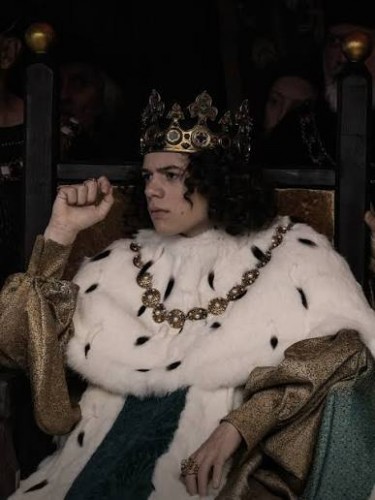
WOODY NORMAN IN THE UPRISING