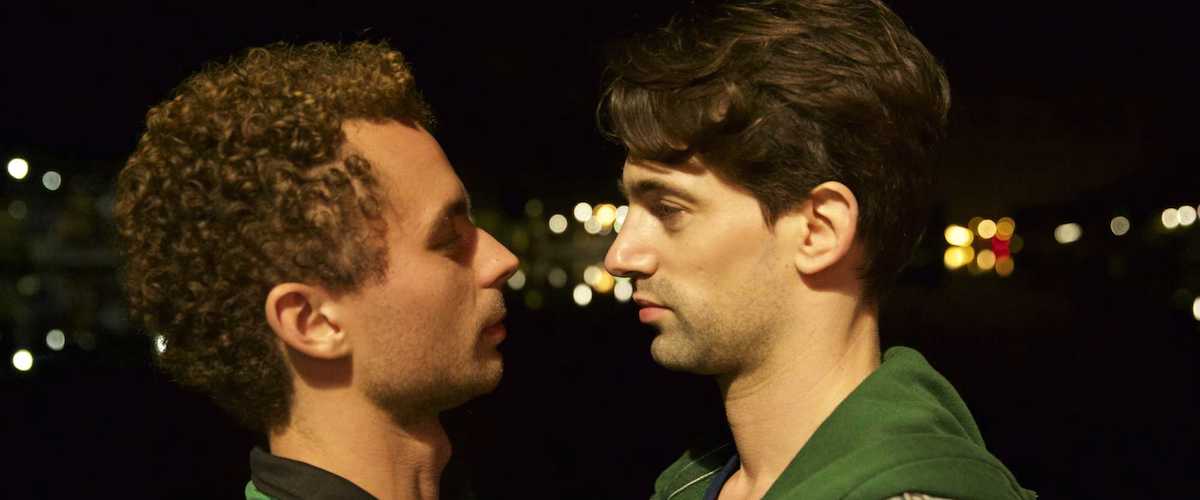
GEOFFREY COUËT, FRANÇOIS NAMBOT IN PARIS 05:59: THÉO & HUGO (2016)
Why the fuss?
Though in some ways this is an uneventful film, it traverses only events in real time of ninety minutes or so, and in a certain way it is a bit sentimental, basically it is strong stuff. Some will not be able to get past the first twenty minutes, a non-stop hardcore all-male sexual orgy that takes place in the darkroom and basement of the Parisian nightspot L'Impact. The rooms lit intensely with red and blue are filled with naked men having intense sex. Two of them dress. leave, and go out into the early morning streets.
it seems to be love at first fuck. Is there such a thing? We may have reason to ask as a lot of the rest, however emotional, is somewhat repetitious. The filmmakers, Ducastel and Martineau have a lot of experience. Their first film was in 1998 - Jeanne et le Garçon formidable, a musical comedy-drama dealing with HIV/AIDS, inspired by the films of Jacques Demy starring Virginie Ledoyen and Mathieu Demy (son of Jacques Demy): they hit the ground running, so to speak, confident of what they wanted to do. This film, their seventh, again deals with HIV/AIDS, and in a more fraught and personal way.
But if the filmmakers want to deal seriously with the disease, for which after 45 years no final cure has been found, they nonetheless are guilty of heightening the drama - "We had unprotected sex, you have AIDS, we used no protection, help!! what can I do?" - when, since the infected guy is consistently taking triple therapy (Antiretroviral Therapy, or ART). and is undetectable means, world health organizations agree, "cannot sexually transmit the virus to an HIV-negative partner." Moreover the uninfected one was the active, the "top," who always is much less at risk of infection. Because the HIV-positive partner is taking effective triple therapy and assuming the passive role, the risk of transmission to the active partner drops all the way to zero.
But that's not how this film plays it, because the top, Théo (Geoffrey Couët), whose openness and sweetness somehow makes him arguably seem a bit more like a bottom, panics when he discovers that the dark, square-jawed Hugo (François Nambot) is living with HIV, because they used no condom. Or was it true what they said to the intern at the hospital where they rush, that the condom broke? They, or Théo anyway, panics, and they do rush to the nearest hospital (Hôpital Saint-Louis, in the 10th arrondissement), where Théo gets set up immediately for emergency post-exposure prophylaxis (PEP) treatment.
Though it's taking on a heavy load to do so, it's clear that for Ducastel and Martineau the "emergency" is only one part, if a big one, of the whole story, which is about sex turning instantly into love. The film captures the special late night out-of-the-sex-club mood, when Théo and Hugo, who hadn't taken any drugs or drunk much, felt an intoxicating magic just off of the place and each other's energy. They're lucky (lucky for us too), Théo gets served quickly, the brief wait - given priority, apparently - interrupted by intense conversation and a homophobic man they have to move away from - ends with a quick interview with an medical intern (played by Claire Deschamps, a real doctor), and Théo provided with treatment to take and briefing on its side effects, which may be unpleasant, and instruction to return for the first checkup in three days.
There is not much more to do now, but they remain together, prolonging the moment, the long night, in the dark, glittering city. Their chatter about what each does - Théo is an architectural intern and Hugo works as an assistant notary - leads to no profound revelations; this is no Before Sunrise. They have two significant encounters. They are hungry and seek a "ptit déj" (breakfast). but it's too early so they find an all-night kebab shop and get chicken kebab, served by a refugee from war in Syria who makes them feel lucky to have grown up in a world without war. They argue, fight, almost split, then don't; reaffirm their love. On the Métro they talk to an older woman (Marief Guittier) who has too small a pension so she must work as a chambermaid in a luxury hotel, and report at dawn.
Paris in this film is the other large unspoken player, of course, a magical place both dark and light: there is blackness everywhere, but lights everywhere too, making streets and buildings glitter and glow. Many shots show the two men's faces up close, brightly lit, staring, and they are still making love, embracing and kissing. Along the way they take rental "Vélib" bikes, they run, they walk along the Canal Saint-Martin and around Place Stalingrad, pausing to talk, connect, and admire the quiet, empty streets of the city before dawn breaks. They take the "first Métro" - this is a big deal for them - to Théo's tiny "maid's room" chambre de bonne apartment near the Anvers metro station. The film concludes on a tender, open-ended note of realistic optimism and mutual commitment. The film has kept us abreast of the moment from time to time and now a digital clock at Théo's shows the titular hour, 05:59. There's no more sex, though Hugo undresses Théo, eulogizing to excess his slim, young body and vividly admiring his truly impressive sex.
Isn't the danger Théo is allowed to feel - even by the professional at Hôpital Saint-Louis - based on misinformation? Basically it is, and since for gay men to know about every accurate detail of HIV is essential this seems a failure of responsibility by the gay directors. Nonetheless this is as passionate and convincing-feeling a gay encounter as you're likely to see in a film and for that it should be seen. It's the kind of film that pushes everything else out of your mind: it's totally self-absorbed, but in a good way because it's passionate and innocent and has such a good heart.
This is a film that for me slipped through the cracks so I have only just seen it now, nine years after its limited US release. I also reviewed their My Life on Ice (Ma vraie vie à Rouen (2002). At present you can watch Paris 05:59 HERE or HERE.
Paris 05:59: Théo & Hugo/, French title: Théo et Hugo dans le même bateau (a playful pun on the title of Jacques Rivette's 1974 classic film Céline and Julie Go Boating /Céline et Julie vont en bateau), 97 mins., premiered at the Berlinale, Feb. 15, 2026, and over 50 other festivals, mostly LGBT ones. US theatrical release Jan. 27, 2017. Metacritic rating: 74.
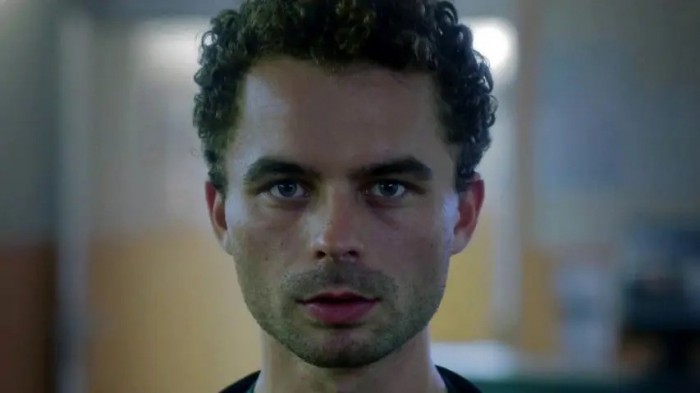
GEOFFREY COUËT IN PARIS 05:59: THÉO & HUGO (2016)