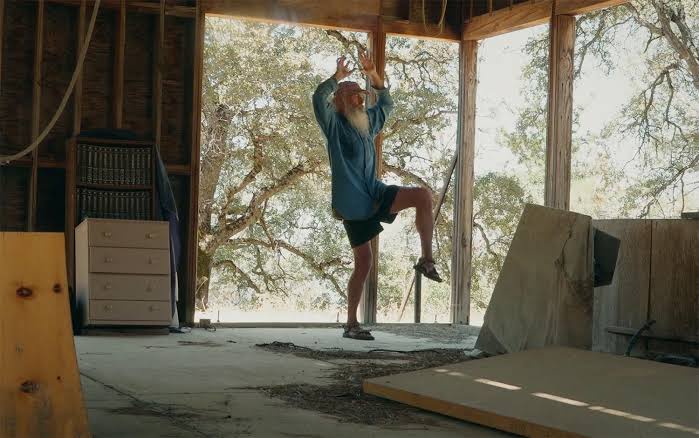
JIM TICKENOR IN THE BEND IN THE RIVER
Colorado river friends, aging, lose their physicality
How brutal time is: it makes people get old. Their skin's not as smooth, their bodies aren't perfect anymore. That's the first message of this final panel in Robb Ross's initially very hedonistic documentary film trilogy following five friends whom he has known since childhood, who live and work near the Colorado river and were river guides and rapids runners in their youth. Glimpsed in golden flashbacks early on here, they are Danny Silver, Jim Tickenor, Cathy Shaw, Jeff Golden, and Barry Wasserman. (If you have watched the first two films you will know them better.) Ross softens this message. His people do get old, someone gets testicular cancer, someone loses part of a leg, they don't run the rapids anymore. But they're still fit and cheerful, they go on being active into this, their early seventies. They seem for the most part comfortably off, middle class white people living the good life.
This is not the Louds, the subjects of the famous 1973 PBS "American Family" series, which really made you think, and dove into private lives. It celebrates physicality, and Bend starts with footage of the friends cavorting around the river "clothing optional" style, showing off their smooth, brown, largely naked bodies as shot for the earlier films, footage of which Moss makes liberal use for contrast, and continuity, and to continue the trilogy's celebration of these folks' glorious early hedonism.
This is (presumably) the final panel in Robb Moss's "River Trilogy" documentary , following Riverdogs (1982) and The Same River Twice (2003) . Moss is a pioneer of personal documentary filmmaking and a professor in the Department of Art, Film, and Visual Studies at Harvard University. Over forty years: that's monumental. Riverdogs is a glorious trip of the group on the river, perhaps the most spectacular camerawork. The Same River Twice has a lot of material that will be referenced again in the new film but much more about marrying and having kids, the heart of their adult lives.
A documentary needs a point, or needs to find one. Maybe this one has more of a that for viewers of the first two in the trilogy that's simple, and applies to all documentary chronicles of people: just to show how they look and what they are doing at a later stage; revisit them on film. Look, here they are, still alive, a little older, doing tdifferent things: form your own conclusions. Veterans of the trilogy's first two panel will recognize the people. To jog their memory, their earlier selves are frequently cut in next to views of their current ones, as reminders. Reminders: and also in a sense "memento mori," perhaps. Youth is gone, and old age and death now are mentioned. These eventualities are now in view, though not yet looming, not yet for all, anyway, given today's health spans - that is, for healthy, well-off white Americans like these.
In fact it's hard to watch this film without wondering what other not so fortunate demographics will think of it. You may not relate, even if you are white, American, and middle-class. Perhaps you are older. Perhaps you are younger. Perhaps you are more urban, less outdoorsy. Perhaps you find nudism a bit self indulgent, irrelevant. Perhaps your youth was less sporty ahd more intellectual. But the nudism, photogenic as it is, has to be included because it ia a part of who they were. It's simply a sign of the glorious physicality of these men and women in their twenties. Naked, they all looked alike. It's now that they are individuals. The men, uniformly bearded then, it seemed, now mostly aren't.
But the environmental changes are more visible. You will be shocked at how much lower the waters of the Colorado have dropped - geologic time in a decade, someone says.
Supposing you have not seen the first two films. What will you learn?
One man gets more attention than others, Barry Wasserman. (He is traveling with the director for Q&As at preview screenings.) He runs for mayor of Placerville, wins, later loses. He gets a lucrative and more worthwhile job running a mental health facility and supports his wife and children. He gets testicular cancer, is treated, and survives. He is very glad now that he did. Watching the film, Barry realizes what an ordeal his illness was for his family. He has been open about the cancer to the camera, but he admits withholding the news from some of those closest to him who most needed to know. He is humorous. From what we see of him, he is brave and admirable. He has divorced and remarried, introduces Lucas, his first grandchild, and greets a man with Alzheimer's who lives nearby and wanders over to his house.
There is another man, Jim, who does not do so well at this point. He has been promising to build a house, started in the span of the second film, but it's only partly finished now after years. He has lost two front teeth, and the remaining gaps suggest that he hasn't the money for expensive dental work to fill in the gaps. Still, with his long white beard dancing in his unfinished house, he seems some kind of crazy guru. His frequent laugh is between happy and deranged.
Another story is of Danny. She had a good job in genetics in New Mexico, but recounts how her boss expected everyone to report their every movement by smartphone, including lunch. Seeking freedom, she came home and became an aerobics teacher, which she seems to practice happily into past middle age. But Danny now recalls all who once lived in her house (husband, children, pets) who have now gone away: "It was a full house… and now it’s me," she says. This is symbolic of the paring down that all experience with age. Traditional grandparents may look over and be looked over by dozens of in-laws and offspring and grandchildren. Moss has followed representatives of his counterculture Boomer generation who were wild and free, nudist and anti-establishment river guides in their youth, divorced in middle age, whose lives did not lead so much toward building a traditional family.
Moss's trilogy (though I haven't seen the first panel yet) forms an interesting contrast to the British 7 Up, etc., series, which my generation found brilliant and tremendously moving. It zeroed in with a laser focus on individuals in those seven-year intervals. There have been seven iterations in the series. The individuals, their lives sometimes altered by the coverage, otherwise unconnected and socially diverse. The Up series focus is not on shared surroundings and social environments. Moss by focusing on both dilutes both, though he provides what is to some degree a portrait of a single social group. The collective effect of the trilogy spreads out now. Moss is no longer filming youths who work out and play together on the river anymore, but they still share forever that past.
Moss's film provides a stunning image of the (threatened) vibrancy of an environment and the aging of a young generation of twenty-somethings who originally inhabit it, mature, and begin to grow old as it is altered by climate change. This series has the opportunity of becoming monumental in its own right, especially if it is studied and can continue as a series into old age. Certainly a series to learn more about.
The Bend in the River, 82 mins., premiered at Telluride Aug. 31, 2025 (see review by Dan Mecca in The Film Stage), and was also shown at Woodstock, Middleburg, Santa Fe, LONDOCS, Blue Sky, Sedona, and other film festivals. For the US theatrical debut, the film, which has been acquired by Netflix (streaming release Dec. 17, will be shown at Film Forum in New York, which will feature all three films in the trilogy, starting Aug. 12, with Q%As featuring the director, with Barry Wasserman for The Same River Twice and The Bend in the River. Limited US release from Aug. 14, 2026.