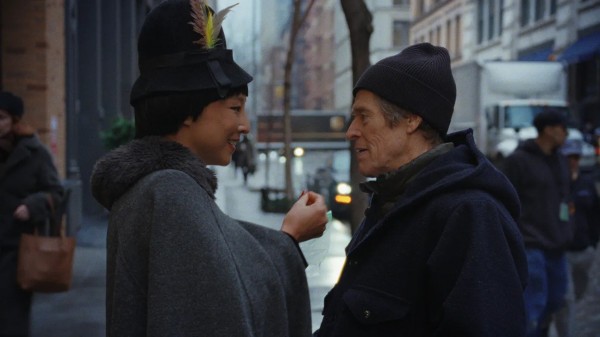
GRETA LEE AND WILLEM DAFOE IN LATE FAME
Willem Dafoe and 'Late Fame;" a longer view
At 21, restless and craving something more, in the mid-1970's William (soon to re-dub himself "Willem") Dafoe walked away from his studies at the University of Wisconsin–Milwaukee with no degree and no plan, only a hunger to act. Besides thespian skills, he had the assets of chutzpah and striking looks - a big forehead, prominent cheekbones, a strong chin, and a full head of flowing light brown locks. He went straight to New York and entered experimental theater by becoming a founding and charter member of the Wooster Group, which became a constant for him from 1977 to 2005. How this led to fame in movies like Platoon (1986), Jesus in Scorsese's experimental The Last Temptation of Christ (1988), Green Goblin in Spider-Man (2002), and roles in The Lighthouse (2019), The Florida Project (2017), Finding Nemo (2003), and on and on and on, is a bit of a mystery. But the springboards were the role of Eric " Rick" Masters, a sly counterfeiter, in William Friedkin's 1985 neo-noir To Live and Die in L.A. and getting a Best Supporting Actor Oscar nom for the key role of Sergeant Elias Thorne in Oliver Stone's Platoon the following year.
Dafoe goes back to his low-keyed indie roots to play the lead in Kent Jones' sophomore directorial effort, Late Fame, the story based on a short work by Arthur Schnitzler of how a group of well-heeled young poetasters in today's NYC pluck a forgotten working class poet who produced one admired slim volume in the 1970s out of the post office where he's been sorting mail for 37 years and give him a moment of, not fame, of course - they, who anachronistically call themselves The Enthusiasm Society, abhor social media platforms - but of affirmation, a wistful hint of what might have been if he had gone on writing poetry over the last many decades, and a realization that that cannot be.
Dafoe's character here, Ed Saxberger, is a low-keyed but central role. Dafoe's typically excellent job as an actor here involves wordlessly projecting the complexity of "Saxberger," as The Enthusiasm Society's pompous leader Myers (Edmund Donovan) calls him - one of their retro gestures is to call each other by their last names. Ed is stolid and shut down; working class, yet deeply sensitive; and his sleeping ego is awakened by being "rediscovered," signaled by an interview with an agent, a family connection of Myers played by Jake Lacy, who so memorably played Shane Patton, the wealthy, entitled, and petulant newlywed in the first season of "White Lotus."
The Enthusiasts, however pretentious, seem to have been genuinely captivated by Ed's slim 1979 volume Way Past Go. Jones isn't quite successful at the task of bringing this group to life, except for Myers and one female semi-member, Gloria (the star of Past Lives, Greta Lee). Ed meets with Myers at his outlandishly spacious digs, where Myers shows off to him a $1,200 first edition of William Burroughs' Naked Lunch bought at Foyles, in London. All the while the strains of Wagner echo creepily in the background. Myers seems different in different scenes, but he is an interesting personality of almost Jamesian pretension, a sign of Kent Jones' capability for in-depth imagining of characters, when he chooses.
Gloria, the other one of these, is older, and mysterious. Involved with another man she endeavors to conceal, she flirts shamelessly with Ed as she has with men surrounding the group. Ed is interested, seduced, one might say, as he is, resistantly at first, then affably giving in, by this new adulation of a past self. There is a buildup for a "reading," another intentional anachronism of The Enthusiasts, where Myers proposes that "Saxberger" will read a new poem he will have composed for the occasion. Or so they think. Myers also proposes that Ed write a memoir, which the agent has been led to expect. None of this is going to happen.
One of Ed's primary roles for the young would-be writers, and for us, is to recall the intense downtown New York scene of the 1970's of which he was a part, when he, barely more than a teenager and doubtlessly attractive to men and women, knew Robert Creeley and so many others who are gone, when poets (and folk singers, though that's not mentioned) were at every cafe, readings were almost daily, the Village a hotbed of creativity that died out in the AIDS crisis (also not mentioned).
But Ed, who had to embed himself in hard work, choosing the post office like Bukowski (of whom however he is unaware) to continue living even in his lowly walkup, with no time for the literary life. He has't even thought about poetry for many years, and it turns out that producing it after long absence isn't like riding a bicycle. He tries, but can't even compose a limerick. He's used to the off-the-job society only of his working class beer-and-pool buddies, who don't know from poetry and whom he doesn't want to attend the reading.
Much is required of Greta Lee here, who is expected to perform an old poem of Ed's for the reading. Before that we see her deliver a mesmerizing performance of Brecht/Weill’s “Surabaya Johnny" where she curls and poses on a stool with all the elegant seductiveness of a latter day Asian Marlene Dietrich. It's a highlight of the film: even if Lee/Gloria's extremism is a little embarrassing - it's meant to be. Everybody here is a little embarrassing, except Ed Saxberger, who decides, perforce but contentedly, that the pretenses of these young well-off litterateurs are less desirable than a return to the comfort of his ordinary, unfamous life.
Much of this film is in its way priceless, with Dafoe reliably delivering a lived-in performance that's both subtle and authentic. Only the low key and the lack of a payoff hamper the film. It feels like a collection of vignettes, linked by one solid, slightly stolid character with a group of shrill oddballs temporarily around him. But Kent Jones is someone special. Besides directing the New York Film Festival from 2013 to 2019, he often collaborates on documentary projects with Martin Scorsese, and in 2015 made the essential doc Hitchcock/Truffaut. His first feature, Diane (2018), is highly praised (its Metacritic score is 86%). In an admiring Variety review of Late Fame, Owen Gleiberman points to curiosity as the writer-director's leading trait. This suggests probing character, which he does discerningly here, rather than springboarding action. Hence we should not care that the outcome is Ed's implied decision to remain who he is now; our aim is to follow Jones as he probes into that identity. And what better gentle guide than Willem Dafoe?
Late Fame, 96 mins., premiered at the New York Film Festival Sept. 28, 2025, showing also at Vienna, Stockholm, Thessaloniki, Ljubljana, Geneva, Rotterdam, Glasgow, and a dozen other festivals including Milwaukee and San Francisco, where it will kick off the festival at the Castro Theatre with Greta Lee and Willem Dafoe on hand. It will be the opener also at Jeonju. US theatrical release: Fri., Aug. 7, 2026 at Film Forum, NYC (all shows sold out., standby only). San Francisco: The Vogue Theater Sept. 9. Metacritic rating: 78%.
Mike D'Angelo has a review.