MY UNDESIRABLE FRIENDS
JULIA LOKTEV, ANNA NEMZER: MY UNDESIRABLE FRIENDS: PART II – EXILE (2026) NYFF
The young and the bold
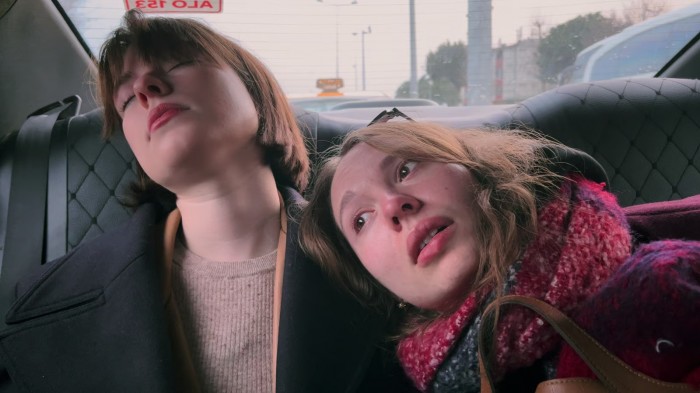
Documentary filmmaker Julia Loktev was an early emigre. Arriving in the US from Russia at the age of nine in the US from Russia (then the Soviet Union) with her family in 1978, she grew up in Colorado and studied later in NYU's graduate film program. She prepared for Parts I and II by by embedding herself intimately and informally among independent Russian journalists, bloggers, and activists. In Part (Last Air in Moscow) I Loktev followed these lively people when they faced severe state suppression, surveillance, and "foreign agent" labeling by Vladimir Putin's regime from late 2021 through the outbreak of the war in Ukraine.
Apart from the charm, sexiness, and courage of these journalists, more of whom are women than men, Loktev (and now Nemzer) provide a picture of the decline of freedom in Russia and the deterioration of life under Putin. This is an extraordinarily vivid way of experiencing these crucial and unfortunate developments. There is almost a day-by-day feel in the intimate soap opera the film provides, with specific personalities highlighted with portrait stills at the end of each section.
The fruit of that filmmaking appeared in Loktev's Part I at the New York Film Festival in 2024. Now two years later for Part II we have the same people as most of them are forced to leave Russia. Perhaps one or two remain, but the crackdown on freedom of the press grows increasingly intense in the period covered by Part II. It is vivid and alive, but the film is six hours long, and at one sitting it may prove hard going, festival film viewing only for the hardy. In workable installments watched at home on MUBI or another streaming channel, like taking up knitting, My Undesirable Friends is enjoyable and thought-provoking stuff. Being a TV team, by the way, these people are ready to be looked at.
A lot of attention is focused in Part II on an independent Russian TV channel called Dozhd (Rain). Following the invasion of Ukraine, the Russian government blocked the channel, whose broadcasters openly opposed the war, and passed strict censorship laws (which were to become yet more harsh) criminalizing independent coverage. "Fake news". and "terrorist" are words bandied about. The film follows the Rain team and spends btime with them in Latvia, where they reassembled - but not forever. Alexey Korostelev used the phrase "our army" speaking of the Russian army in a broadcast, which disturbed and allegedly confused the Latvians, and Koreselev was immediately fired by his supervisor. The film later shows the owner of the channel, Natalya Sindeyeva, who weeps over the excessiveness of this step ad others taken. Dozhd moves to Amsterdam. Later Latvia changes their mind and reinstates Dozhd.
Rain survives, but numerous of its team memberrs disburse to different countries, including to New York, where the film follows them for a whle. The story of TV Rain is enough material, if framed properly, for a film in itself. In moving around among various journalists the film may cause some confusion to the viewer. The film's structure and even Loktev's title - "My Undesirable Friends" - shows that Loktev from first to last has been more interested in personalities than in specific stories. Not that this film doesn't care very much about politics and the news and what has happened in a Russia to which these young, ardent journalists now realize they may not be able to return even perhaps for decades.
As Part II draws to a close, While her colleague Ksenia "Ksyusha" Mironova bravely risks returning to a Moscow courtroom to witness the real-world sentencing of her incarcerated fiancé Ivan Safronov, Lera Ratnikova — a former anchor for the channel - and a real babe —is shown in exile tracking the absurdities of the Russian legal system as it targets her from afar, listening to her "trial' and commenting, smiling, even laughing.
But none of this is really funny. We observe how deeply troubled everyone under Loktev's lenses becomes when the leading Russian dissident and crusader against corruption Alexei Novalny dies in prison, more personally so when several of their number seems to have been poisoned as Novalny was, and they realize they are not safe simply by being outside Russia. One can sympathize ultimately less perhaps with the zoftig and bold Lera Ratnikova and more with sad Natalya Sindeyeva's tears, at the same time feeling a growing sense of horror throughout this very entertaining, if someone overlong film at what it portends for other countries whose leaders admire Putin and would emulate Russia's steady drift back into totalitarianism. My Undesirable Friends: Part II - Exile, like Part I, is a powerful testament to resilience, capturing the profound courage of these journalists who refused to let state oppression win. The film is an outstanding example of documentary filmmaking that's disturbing yet almost too entertaining to be true.
My Undesirable Friends: Part II - Exile, 355 mins., premiered at Venice Sept. 4, 2026, showing also at Telluride, New York and Mill Valley. US limited theatrical release Oct. 9. Metacritic rating: 91%.