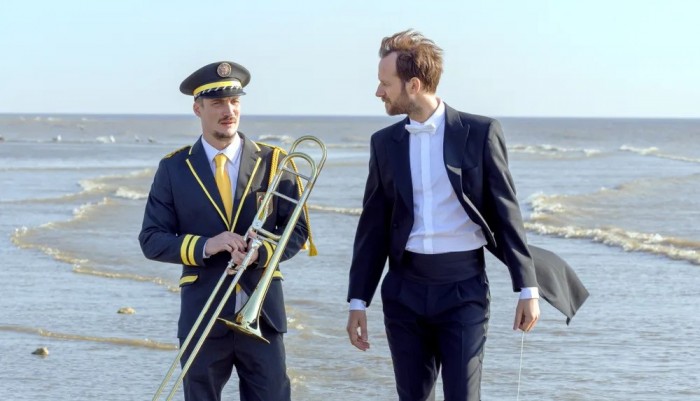
PIERRE LOTTIN AND BENJAMIN LAVERNHE IN THE MARCHING BAND
DIRECTOR'S INTRO
A stirring French exploration of genetics, privilege - and music
The ironies of nature and nurture arise when a world-famous orchestra conductor discovers a brother he never knew he had. He is a school cafeteria worker who plays trombone in a local marching band. They have nothing in common but music but the conductor feels he must atone for the better background that enabled him to do so much more with that ability. But another factor, blood type, arises. The maestro, who collapses while rehearsing a rousing interpretationl of Beethoven's Egmont Overture, Op. 84, has been diagnosed with leukemia. A test of his sister Rose (Mathilde Courcol-Rozès) reveals that he was adopted and she is not compatible for a bone marrow (moelle) transfusion, which the brother is. But this is just the starting point of a struggle to come together between the two brothers, famous conductor Thibaut (Benjamin Lavernhe), raised in Meudon, basically a nice suburb of Paris, and lowly employee and trombone player in a volunteer band Jimmy (Pierre Lottin), born in Tourcoing, in Haut-de-France, and raised as a Ch'ti, a denzen of the harsh northeastern part of the the country.
Despite granting the transplant Jimmy is understandably very standoffish at first, but he is encouraged by Thibaut, who gives him a professional-quality trombone, aspires to too much, too soon, and falls back, despairing. The film captures the moral despair of the post-industrial north. That may be its real, and haunting, theme.
Le Monde's Editor in Chief Michel Guerin remarks that the contrast between the two men and their "forced reconciliation" "feels almost contrived from the start," but forgives it, "thanks to its unbridled affection for the characters and a direction that is guided by the rhythm of the lyrics." Et voilà! But it is a struggle, and we follow it, feeling the two men come close. Thibaut discovers Jimhy has perfect pitch and that clinches it: Jimmy could have been a fine musician, he has the gene. Instead he is in a town where the factory is being stripped out of its machinery (leaving good acoustics, though), a place of diminishing expectations, divorced, rarely seeing his red-headed daughter Justine (Gabrielle Claeys), who's in her early teens. Justine's momentary appearance (thanks to the red hair?) is more memorable than any of the other secondary characters, though the woman who raised Jimmy, Claudine (played by Clémence Massart), is admirably stolid and regional. Casting is impeccable throughout.
Thibaut suffers a major medical setback when his body begins to reject Jimmy's initial bone marrow transplant. Thibaut cannot fight nature and illness, though he achieves the ultimate accolade for a new orchestral compoosition of his own that is a sensation - followed by a ˆcoup de théâtre - Jimmy's band performing an accompanying vocal transcription of Ravel's Bolero.
At a particularly emotional moment, at night an exhausted Thibaut is riding in a car up north with Jimmy and Jimmy is weeping as they listen to the song "Emmenez-moi," one of Charles Aznavour's most stirring and iconic hits, whose lyrics tell the story of a person dreaming of escaping from a dreary, ordinary life into a sunny, faraway land. The two brothers are played with great accuracy by Benjamin Lavernhe and Pierre Lottin, who is especially memorable in his role as a Ch'ti, a down-to-earth, passionate man of the French north.
This is a film that in every way revels in music. There is a key sequence midway when Thibaut discovers Jimmy has a superb collection of jazz on vinyl and they share an enthusiasm over that, thus beginning to bridge their massive social and cultural divide through music. They listen to "I Remember Clifford" – composed by Benny Golson. The film prominently highlights versions of this famous jazz standard, including the iconic rendition by trumpet player Lee Morgan. Also Birth of the Cool – the brothers specifically look through and bond over the legendary Miles Davis compilation album. Clifford Brown and Benny Goodman's recordings and musical styles are also explicitly discussed by them - all acting as a bridge between Jimmy's amateur brass band background and Thibaut's classical training. After the clashing sound of the marching band, Thibaut's classical orchestra each time sounds marvelous,; so classical never gets slighted, and our ears stay tuned.
As the film ends we may not so easily "feel good" after all, but we've been been moved by the depth of blood ties, or rather, genetics, as well as the deep significance nonetheless of the benefits you get growing up -- and overall the magic of music, and in a classy, not corny way. And what's moving (though a little distracting) is to realize what one learns later, and suspects now, that the band in the film is played by a real band, members from the Municipal Miners' Band of Lallaing. At the film's premiere at the Cannes Film Festival, the musicians famously performed an emotional rendition of "Emmenez-moi" live to a standing ovation. And that's how you make buzz that leads to a popular hit. We can, finally, see what he means when Emmanuel Courcol says he is above all a writer, and we can see his design as the film unfolds. But the action all just keeps coming so fast and hard that we don't care.
The enemy music is country, advocated by a trouble-making mayor. This some may have mixed feelings about with the general celebration of Dolly Parton.
The Marching Band, French title En fanfare, 102 mins., debuted at Cannes 2024 "Premieres" section. Its AlloCiné ratings are press 3.8, spectators 4.3. Metacritic: no rating yet. Released in the US by Greenwich Entertainment, the film is now showing in theaters.