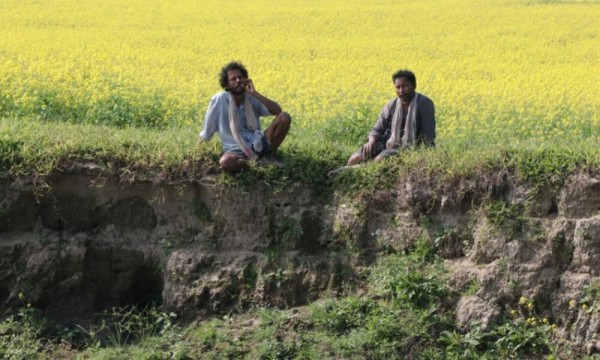
 DR. PANKAJ BORAH: RIVER TALES (2025) NEW YORK ASIAN FILM FESTIVALDire poverty of a fisherman on an Assam river
The river is eternal, the closing shot suggests, with its peaceful background of traditional Indian music of reed flute and percussion. Except in this present world we know it's not. As a young teenager I was entranced by the colorful picture of India in Jean Renoir's 1951
The River, where the river was of course the Ganges. But that was the hopeful Fifties, and the humanistic cinema of Renoir. Dr. Pankaj Borah, in the northeast Assam state of India, is more of an ethnographer and a socialogist. His is a different "river," a doomed eco-system, beset on all sides, a rural community where the young men are going to cities for any job they can get. Borah has made a sadder, more violent film than Renoir's, remarkably real-seeming in its local detail but more docudrama than work of art. The authenticity is breathtaking and reminiscent of some recent African films I've seen, which also, like this, dramatize intense village conflicts, only here without the African sense of humor and vivacity. People seem tired here. Unlike Renoir's
The River, River Tales wouldn't have entranced me as a youth. Dr Pankaj Borah is a teacher, literally and as a filmmaker. He even has a small text message that appears at the bottom of scenes with smoking or drinking that advises us that they're bad for the health. So this is in its way an accomplished film, but it betrays the humanistic tradition of Satyajit Ray.
The river tales are more like episodes in the life and death of Tilou (Raju Roy), a lean and fit-looking Assam State fisherman approaching forty who is eking out a precarious existence on the Ratuwa River, as his family has done for many generations, but it comes to an end because multiple dams, plus people buying or renting tracts of land and making fishing grounds off limits, is killing off the fishing opportunities and the river itself is shrinking and losing its fish. Tilou lives with his wife Bassanti (Meghali Kalita) and two children in great poverty. Repeatedly Borah shows us painful visits by Tilou to a haughty local grocer or other purveyor where his credit is running out.
This is a sharp depiction at certain moments of the naiveté of both adults and children, and of course of their quaint customs and beliefs. The river is a god to them, who they pray to and for, but their prayers are futile now. When someone dies, his widow is persuaded to allow their cow, both a beloved pet and their most valuable possession, to be sacrificed to save the deceased one's soul. Rituals seem more destructive than healing. Likewise a traditional theatrical performance seems as much terrifying and violent as entertaining. One sees small children in the audience and wonders how traumatic this might be without the helpful normalization of violence provided by TV.
Tilou ultimately gives up his ancestral occupation but gets a job as a rickshaw driver so he can remain near his family and not go to the city, but things go vey badly for him. Already he has become angry and done a very destructive, hostile thing. One feels the closeness of provincial society more as resentments than support here. A dark picture emerges, even though there are hints of light. The kids are chirping away at their lessons. Tilou and his wife seem drawn to each other to make love one evening beside the tiny kerosene flame in their grass hut, but she holds off, saying "the children might hear." Indeed they live in very close quarters, and we often are taken to visit from outside the imposing colonial-style house of the merchant, for contrast.
There is a look at politics too, with several regional political meetings, outdoors and very small, and hints that the right politician could help save the river. But Tilou mocks this idea, showing that he's ignorant as well as helpless - and smoking and drinking too, which is bad for his health! In his focus on message and sociological and ethnographic detail, Borah neglects character, not developing anyone other than Tilou, and him only externally. While impressive in its way, and
River Tales can be called a "promising debut" as Panos Kotzathanasis wrote in
Asian Movie Pulse, it felt to me overly negative and not as accomplished in cinematic or artistic as it might have been. Perhaps in future efforts he'll move in those directions.
River Tales নৈ কথা (Assamese: "No Words") with somewhat strange English subs, 103 mins., was screened for this review as part of the New York Asian Film Festival, its international premiere.
Showtime:
Sunday July 19, 1:30pm
SVA Theatre (333 W 23rd St)


 FAQ
FAQ Search
 Login
Login
