FRANCESCO SOSSAI: LAST ONE FOR THE ROAD /LE CITTÀ DI PIANURA (2025)
LIMITED US RELEASE BEGINS MAY 1 (NY) AND MAY 8 (LA)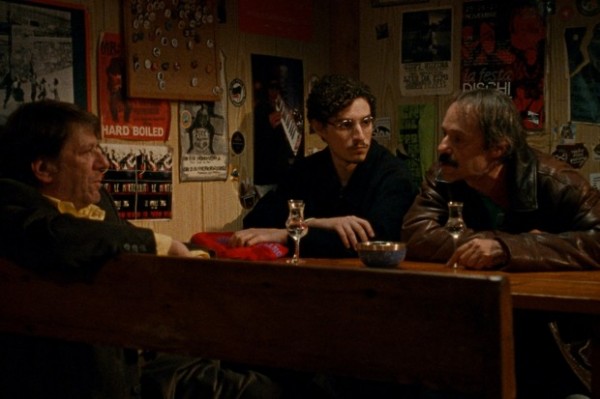 PIERPAOLO CAPOVILLA, FILIPPO SCOTTI, SERGIO ROMANO IN LAST ONE FOR THE ROADTRAILER FILM CLIP
INTERVIEW with Sossai by Dennis Lim at the NYFF"Non c'è mai 'un'altra volta'" (There's never a 'next time')Ingratiating and grating, profound and superficial. This film is all those things, and also a portrait or rough tour of Italy's Veneto region. The principals are amiable men, two blustery and heavy drinking fifty-somethings called Carlobianchi (Sergio Romano) and Doriano (Pierpaolo Capovilla) who somehow pick up a young architectural student, Giulio (prizewinning young actor Filippo Scotti of Sorrentino's
The Hand of God) and take him along on their marathon drinking tour of the countryside.
Doriano and Carlobianchi reflect Italy's sense of failure, perhaps, but also its ways of coping. What could be more
dolce far niente than their bar-hopping? The joke is they are forever pursuing their "last drink," though the American re-title is misleading. This film's original name is "Le città di pianura," "The Cities of the Plain." The sad fact is that it's a ravaged region, the Veneto, full of "plains" that are neither urban nor rural any more. Sossai is interested in both capturing an Italian mood and celebrating the architecture of the local region, whose beauties and unique features the Veneto pair is reminded of by Giulio, the boy from Naples who wants to go home to make a date with a girl next day, but gives up eventually and is drawn into his elder companions' curiously tempting misbehavior and ability to seize the moment because "there's never a 'next time' (non c'è mai un'altra volta").
Carlo Scarpa's architectural masterpiece, the tomb or rather "garden for the dead" for the Brion family in San Vito d'Altivole near Treviso is visited by the three at the prompting of Giulio, who has seen only the plans and is surprised how much more beautiful the actual place is.
Thomas Laffly in
Variety points out that the film is "beautifully shot" on film stock, also that it provides an interwoven tale that shows us many different architectural structures, "mansions and modern buildings alike," and skillful interweavings of flashbacks with the present that show Sossai's "filmmaking panache". He suggests that the "effortlessly off-the-cuff rhythms" of the script recall Richard Linklater. There are references that range from the invention of the nostalgic wink at the nineties via speculation about the origins of the shrimp cocktail to an architect who died in Japan but is buried in the garden cemetery standing up "like a Samurai." This is an endlessly rich and ingenious film whose apparent meandering triviality --though some viewers may object to it-- is very deceptive. "When it all starts feeling a bit repetitive," Laffly writes, "a dash of suspense lifts up the movie with the trio teaming up for a petty con while sipping luscious daiquiris."
There is also a long con recounted from decades earlier of grabbing discarded eyeglasses from a factory and reselling them cheap, which becomes so profitable it becomes not a petty but a grand con, and their pal Genio (Andrea Pennacchi), the most heavily involved in it, fled to Argentina decades ago. It was to meet him on his return that they have gone to the wrong airport this morning. Later in the day they run into him, and he dodges them--a long tale that is verified, then thrown away, very typical of the writing here.
There is also the Count who shows the trio his villa, thinking they are the architects he is expecting to help him deal with a planned freeway that's going to destroy part of his property and all of his peace of mind. By this point Giulio has been drawn into the spirit of casual scam of the older men. And when one of them French kisses the Count, that's a scam too because he comes away with a fistful of euros. Have these two pals ever ceased being con men?
A passage from the Italian government film website
Italy for Movies incorporating an interview with Francesco Sossai helps underline my point that this film is more about Italy and place than just a bromance road movie about alcoholics, (even though it's that too):
"
The protagonist is the Veneto region, a lost rural worldA story both local and universal [the
La Repubblica review called it 'deeply local and surprisingly universal'], filmed in various locations across the Veneto plain, between the provinces of Belluno and Treviso, in Sedico and the Feltre area, Padua and Chioggia, and even Venice . Places the director prefers to call earth rather than territory, a term he believes is overused and linked more to the concept of selling than to belonging. A semantic shift that speaks volumes about the fact that virtually nothing remains of rural Veneto, he emphasizes: 'What you breathe in the countryside is an air of urban solitude. This is the main feeling I wanted to convey in the film; that of a countryside that is no longer countryside but has not yet become a city. To explore the soul of a region that has become a rich cemetery; everything not related to commodities is disappearing, ecosystems are polluted, old homes abandoned or destroyed in favor of characterless residential buildings. Peasant civilization belonged to a place, it was an emanation of the land itself. A form of life that permeated these spaces for long centuries is now gone. You could say I shot the film among the ruins of that Veneto.'"
A Neopolitan hotel clerk in Rome once said to me, "Non è vero che l'Italia è il giardino del mondo, e Roma è il giardino d'Italia?", "Isn't it true that Italy is the garden of the world, and Rome is the garden of Italy?" Well, if the stones of Rome may be eternal, parts of that larger garden are putrefying from within due to economic pressures and modernization. But the film is very region-specific, and names like Mestre and Treviso are not just local color.
This is one of those adorable films that has a bitter underside and a deceptive simplicity, but above all it's an engagingly casual interweaving of places and tales. If not one of the best internationally, it gets my vote for the year's best Italian film with international resonance, justifying its premiere in Un Certain Regard at Cannes and showings at Toronto and the New York Film Festival, as well as Mill Valley.
The Last One for the Road/Le città di pianura,100 mins. , May premiere at Cannes in Un Certain Regard, showing also at TIFF and the NYFF. Theatrical release 23 Sept. 2025 Italy. Now released in the US by Music Box Films, starting with New York (Lincoln Center) May 1 and Los Angeles (Laemmle Royal) May 8.
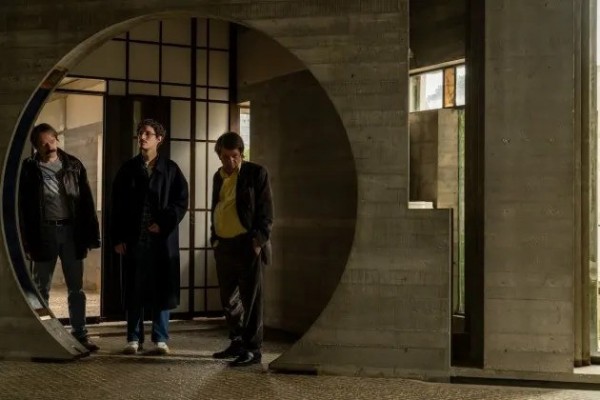 ROMANO, SCOTTI, CAPOVILLA AT CARLO SCARPA'S BRION TOMB NEAR TREVISO



 FAQ
FAQ Search
 Login
Login
