The Regime Change Temptation in Venezuela
If Past Is Prologue, a U.S. Attempt to Overthrow Maduro Would Not End Well
Alexander B. Downes and Lindsey A. O’Rourke
FOREIGN AFFAIRS, October 31, 2025 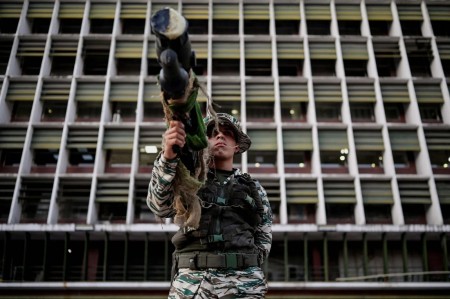 A member of the Bolivarian Militia of Venezuela in Caracas, Venezuela, October 2025
Gaby Oraa / ReutersWhat began in early September as a series of American airstrikes on boats in the Caribbean—which U.S. officials alleged were trafficking drugs from Venezuela—now seems to have morphed into a campaign to overthrow Venezuelan dictator Nicolás Maduro. Over the course of two months, President Donald Trump’s administration has deployed 10,000 U.S. troops to the region, amassed at least eight U.S. Navy surface vessels and a submarine around South America’s northern coast, directed B-52 and B-1 bombers to fly near the Venezuelan coastline, and ordered the Gerald R. Ford Carrier Strike Group—which the U.S. Navy calls the “most capable, adaptable, and lethal combat platform in the world”—to U.S. Southern Command’s area of responsibility.
These moves reflect a recent, broad shift in the administration’s policy toward Venezuela. As reported by several major news outlets, for months after Trump’s January inauguration, internal debate pitted long-time advocates of regime change—led by Secretary of State Marco Rubio—against officials who favored a negotiated settlement with Caracas, including the president’s special envoy Richard Grenell. During the first half of 2025, the negotiators held the upper hand: Grenell met with Maduro and struck deals to open Venezuela’s expansive oil and mineral sectors to U.S. firms in exchange for economic reforms and the release of political prisoners. But by mid-July, Rubio reclaimed the initiative by reframing the stakes. Ousting Maduro, he argued, was no longer just about promoting democracy—it was a matter of homeland security. He recast the Venezuelan leader as a narcoterrorist kingpin fueling the United States’ drug crisis and illegal immigration, tying him to the Tren de Aragua gang and claiming that Venezuela was now “governed by a narco-trafficking organization that has empowered itself as a nation state.”
That narrative appears to have persuaded Trump. In July, the president ordered the Pentagon to use military force against certain drug cartels in the region, including Tren de Aragua and Cartel de los Soles, the latter of which the administration claimed was headed by Maduro and his top lieutenants. Two weeks later, the administration doubled the bounty on Maduro’s head from $25 million to $50 million. On October 15, Trump acknowledged to reporters that he had authorized the CIA to conduct covert operations in Venezuela. When asked about his intended next steps, Trump said, “We are certainly looking at land now, because we’ve got the sea very well under control.” According to The New York Times, “American officials have been clear, privately, that the end goal is to drive Mr. Maduro from power.”
But whether covert or overt, any attempt at regime change in Venezuela will face formidable challenges. Covert methods fail far more often than they succeed, and it is unlikely that threats of force or airstrikes will successfully pressure Maduro to flee. And even if Washington were to succeed in ousting Maduro, the longer-term game of regime change would still be risky. Historically, the aftermaths of such operations have been chaotic and violent.
IF AT FIRST YOU DON’T SUCCEED?
The Trump administration has several covert options for bringing about regime change in Venezuela. But by effectively announcing such plans in advance, it has forfeited the primary advantage of acting covertly: minimizing the political and military costs of an operation by preserving plausible deniability. Going public saddles Washington with full responsibility for a mission’s outcome while reducing its ability to control events on the ground should things go awry. In practice, this invites a series of half measures, too overt to be deniable and too limited to be decisive.
But even if Trump had preserved secrecy, the United States’ history of covert interventions offers little reason for optimism. Washington could offer clandestine support to local armed dissidents, try to assassinate Maduro, or instigate a coup against his regime. Yet each tactic carries a poor track record. A 2018 study by one of us (O’Rourke), analyzing 64 U.S.-backed covert regime change attempts during the Cold War, found that efforts to support foreign dissidents succeeded in toppling the target regime in only about ten percent of cases. Assassination efforts have fared no better. Washington’s intentional attempts at covert killings of foreign leaders—most notoriously Cuban leader Fidel Castro—repeatedly failed, although a few leaders, such as South Vietnam’s Ngo Dinh Diem in 1963, were killed during U.S.-backed coups without U.S. approval. Fomenting coups has proved more effective at bringing U.S.-backed forces to power, including in Iran, in 1953, and Guatemala, in 1954. But neither outcome led to long-term stability. And Maduro has so thoroughly coup-proofed the Venezuelan armed forces that this option appears less viable.
The United States has never been able to oust a foreign leader through airpower alone.
Some of these tactics have even been tested in Venezuela before—and failed. In 2019, the United States recognized the opposition leader Juan Guaidó as Venezuela’s interim president and backed a popular uprising against the Maduro regime. But the attempt collapsed when Maduro’s military refused to defect. The following year, a group of about 60 Venezuelan dissidents and a few American contractors launched a botched amphibious incursion to storm the capital and capture Maduro, called “Operation Gideon.” It was swiftly intercepted by Venezuelan security forces.
History shows that failed covert regime changes usually make a bad situation even worse. Relations between the intervening actor and its target go downhill, and as we have found in our research, militarized clashes between them become more likely. In the target state, such attempts tend to trigger violence, including civil war, and increase the risk that the regime kills masses of civilians.
The United States has long conducted covert interventions in other countries’ domestic politics—in Afghanistan, Albania, and Angola, to name just a few. But this pattern was especially pronounced in Latin America, where Washington attempted at least 18 covert regime changes during the Cold War. In 1954, it overthrew Guatemala’s democratically elected government, ushering in a military regime that rounded up thousands of opponents and presided over a 36-year civil war that killed an estimated 200,000 people. In 1961, the United States backed the failed Bay of Pigs invasion of Cuba and launched a coup in the Dominican Republic that unintentionally provoked the assassination of the dictator Rafael Trujillo. After Trujillo’s son seized power instead of the U.S.-backed coup plotters, Washington forced him into exile and continued to meddle in Dominican elections—as well as those in Bolivia and Guyana—throughout the 1960s. It also supported coups in Brazil in 1964, Bolivia in 1971, and Chile in 1973, and funded the Contra rebels in Nicaragua throughout the 1980s.
Yet not one of these operations produced a stable, pro-American democracy. More often, U.S. interventions installed authoritarian regimes or triggered cycles of repression and violence. Even when Washington found a staunch anticommunist ally, such as Augusto Pinochet in Chile, relations eventually soured over the regime’s brutality and human rights abuses. More broadly, the public exposure of Washington’s role in these covert operations fueled deep and lasting anti-Americanism that continues to haunt U.S. policymaking in the region. Indeed, Maduro regularly invokes this history to portray current U.S. pressure as a continuation of Washington’s imperialist past.
POINT BLANK
Among its overt options for regime change, the United States could try to intimidate Maduro into leaving power with threats of force. This technique has sometimes worked, but only against tiny states that are faced with great-power antagonists capable of overwhelming them in a land invasion. In 1940, for example, Joseph Stalin used threats of invasion to oust the leaders of neighboring Estonia, Latvia, and Lithuania. The United States has coerced regime change using threats of force only against essentially defenseless targets, such as Nicaragua in 1909–10. In more recent times, militarized threats by the United States against Saddam Hussein in Iraq and Muammar al-Qaddafi in Libya failed to convince either leader to abdicate.
A second tool Washington could use to induce regime change is airpower, but this is easier said than done. Hypothetically, airstrikes could bring about regime change by killing leaders, cutting off the military’s ability to command its forces, or triggering a military coup or popular uprising. The United States, however, has never been able to oust a foreign leader through airpower alone. Even with the development of precision weapons, it has proved difficult to track and strike heads of state, and the proliferation of communications technologies has made the project of isolating leaders from their militaries extremely difficult. Militaries, for their part, are unlikely to stage a coup while fighting a foreign enemy, such as the United States, and civilians would likely find it difficult to mobilize to oust their regime if they were also trying to dodge bombs. All these challenges helped thwart Israel’s regime change aspirations during its recent air campaign against Iran.
Finally, the United States could invade Venezuela. If it decided to go that route, however, the forces the administration currently has in place would not get the job done. In early October, the Center for Strategic and International Studies estimated that a ground invasion would require at least 50,000 troops. Trump could, theoretically, assemble such a force. But launching a major invasion would starkly contravene his loud and repeated opposition to sending U.S. troops on foreign adventures and risk fracturing his base. Most observers downplay the invasion scenario, instead anticipating, as military experts told The Atlantic in October, a “push the button, watch things explode” campaign. It is also worth recalling that the United States could not control Iraq—a country half the size of Venezuela—with more than three times as many troops in 2003.
It is tempting to invoke previous U.S. invasions to achieve regime change in the Caribbean—such as the 1983 attack on Grenada, which ousted a Marxist regime, or the invasion of Panama in 1989, in which Washington overthrew and extradited the dictator Manuel Noriega—as a model for Venezuela. But both comparisons are deeply misleading. Grenada is a tiny island nation that had a population of roughly 90,000 at the time of the U.S. invasion. Panama offers a slightly better comparison, but it is still nowhere close to Venezuela’s size: Venezuela is more than 12 times as large and has roughly ten times as many people as Panama did in 1989. Unlike Panama, Venezuela is not a small state centered on a capital city but a vast, mountainous country with multiple urban centers, rugged jungle terrain, and porous borders that insurgents and irregular forces could exploit. The U.S. military has not fared well against insurgencies under similar conditions in Vietnam and Afghanistan.
THE DOWNSIDES OF SUCCESS
Even if a regime change operation succeeds at first, history again shows that long-term outcomes are often disappointing. Studies by each of us (and many others) have shown that efforts to promote democracy after foreign-imposed regime changes rarely succeed—a point made painfully clear by recent U.S. interventions in Afghanistan, Iraq, and Libya.
Regime change instead often begets further violence—for example, it dramatically increases the likelihood of civil war in target countries. Even regime changes that result from decisive land victories can go wrong if the targeted state’s armed forces scatter instead of surrendering, allowing those forces to provide the basis for insurgencies against a new regime, as occurred in Iraq.
Venezuela’s internal landscape suggests that this is a real possibility. As the Latin America analyst Juan David Rojas has noted, Venezuela contains a “kaleidoscope of sophisticated armed actors,” including pro-regime militias known as colectivos and transnational armed groups such as the National Liberation Army (ELN) and remnants of the FARC (Revolutionary Armed Forces of Colombia). Phil Gunson, a Caracas-based analyst for the International Crisis Group, told The Guardian in early October that Venezuela “is absolutely packed from end to end with armed groups of various kinds, none of whom has any incentive to just surrender or stop doing what they’re doing.” The chances—and possible consequences—for U.S. missteps are high.
Militaries are unlikely to stage a coup while fighting a foreign enemy.
Whoever replaced Maduro would face significant obstacles—especially if the United States put them there. Leaders brought to power by outside actors are more likely than other leaders to be ousted violently. Indeed, whether overtly or covertly, our research has found that nearly half of externally imposed leaders are later removed by force. Often viewed as weak or illegitimate—either because they lack broad domestic support or are seen as puppets of a foreign government—these leaders struggle to consolidate power. To be sure, Venezuela has a vibrant democratic opposition, and that opposition’s leader, the recent Nobel laureate María Corina Machado, commands a majority of public support. In the country’s July 2024 presidential election, Edmundo González—who became the opposition’s candidate after Machado was barred from running—won more than twice as many votes as Maduro, a result that the government promptly suppressed.
Proponents of regime change argue that it could empower this democratic majority and carry Machado to power. But even public opinion polling favorable to Machado shows that Maduro still retains the loyalty of roughly one-third of the population. That minority importantly includes the core pillars of the regime’s coercive apparatus, whose positions and privileges rely on the survival of the current system. In 2023, a study by the RAND Corporation warned that U.S. military intervention in Venezuela “would be protracted and not easy for the United States to extricate itself from once it begins its engagement.”
All of this points to a broader lesson: democratic revolutions are most likely to succeed when they are indigenous. If Machado truly enjoys widespread support and the opposition truly commands majority sentiment, then their best chance for success is to translate that support into power from within. Aligning their movement with a foreign military risks delegitimizing their cause and inviting nationalist backlash. Moreover, the fact that the opposition is now courting U.S. military assistance should make U.S. policymakers wary. If the political balance really is in their favor, why do they need outside help to topple Maduro? The answer, of course, is that Maduro’s regime still controls the guns. But if the opposition requires foreign backing to seize power, it will also likely struggle to hold it.
History offers no shortage of cautionary tales. Those bent on regime change have repeatedly relied on biased information and rosy assumptions about the aftermath of these operations. When assessing his prospects for installing a puppet regime in Mexico during the 1860s, for example, Napoleon III of France trusted the counsel of exiled Mexican conservatives, who assured him that their countrymen would welcome rule by an Austrian archduke—just as the George W. Bush administration believed the prominent Iraqi exile Ahmed Chalabi’s assurances that all would be well after the overthrow of Saddam Hussein. Both interveners ended up battling powerful insurgencies. The root problem is that interveners tend to focus myopically on how to topple a regime, without giving much thought to what will come after. But as Benjamin Franklin once put it, “If you fail to plan, you are planning to fail.” By neglecting to plan, the Trump administration risks repeating the disasters of Iraq and Libya.
AMERICA FIRST?
A U.S. policy of regime change—its chances of success notwithstanding—would violate every principle of the foreign policy Trump claims to champion. Trump has long railed against the United States’ “forever wars” in Afghanistan and Iraq and vowed to end “the era of endless wars” more broadly. He has repeatedly cast himself as a peacemaker, claiming to have ended eight international wars in nine months. In May, in a speech in Riyadh, Trump praised regional self-determination, declaring, “The birth of a modern Middle East has been brought by the people of the region themselves. . . . The so-called ‘nation builders’ wrecked far more nations than they built—and the interventionalists were intervening in complex societies that they did not even understand themselves.”
A U.S.-engineered effort to topple Maduro would contradict this vision. It would potentially entangle the United States in another open-ended conflict, alienate regional partners amid a broader competition with China for influence in the region, and defy the desires of the American public. A YouGov poll conducted in September found that 62 percent of adult U.S. citizens “strongly or somewhat oppose the U.S. using military force to invade Venezuela,” and 53 percent strongly or somewhat oppose “the U.S. using military force to overthrow Venezuelan President Nicolás Maduro.” (The support for U.S. Navy deployments was more mixed, with 36 percent strongly or somewhat approving “the U.S. sending Navy ships to the sea around Venezuela” and 38 percent strongly or somewhat disapproving.) A poll from early October found that even in Florida’s Miami-Dade County, home to the largest Venezuelan diaspora in the United States, more residents oppose than support the U.S. military being used to oust Maduro, 42 percent to 35 percent.
Nor would regime change advance the administration’s stated goals in the Western Hemisphere: curbing drug trafficking, dismantling cartels, and reducing illegal immigration. For one, Venezuela is not a major supplier of narcotics to the United States. Indeed, the 2024 Drug Enforcement Agency National Drug Threat Assessment does not mention Venezuela at all, and the agency estimates that only eight percent of U.S.-bound cocaine transits its territory. The threat posed by Tren de Aragua also appears overstated. A declassified April memo from the Office of the Director of National Intelligence concluded that the gang’s small size makes it “highly unlikely” that it “coordinates large volumes of human trafficking or migrant smuggling.” Nor is there any clear reason to believe that regime change would stem or reverse the mass emigration from Venezuela. If anything, further destabilizing the regime may only increase the number of refugees fleeing the country.
Despite all this, some might still argue that regime change is justified by the United States’ strategic interest in Venezuelan oil reserves, which are the world’s largest. But negotiations over U.S. access to those resources were working. As The New York Times reported in October, under a deal discussed over the summer, Maduro had “offered to open up all existing and future oil and gold projects to American companies, give preferential contracts to American businesses, reverse the flow of Venezuelan oil exports from China to the United States, and slash his country’s energy and mining contracts with Chinese, Iranian and Russian firms.” This was arguably the most generous package of concessions offered by a foreign adversary to a U.S. administration in decades. And diplomacy was far from exhausted when Trump abruptly walked away. If the administration’s goal is to secure U.S. interests in the region, it would be wiser to return to the negotiating table than to gamble on the chaos that regime change would unleash.
Alexander B. Downes is Professor of Political Science and International Affairs at The George Washington University and author of Catastrophic Success: Why Foreign-Imposed Regime Change Goes Wrong.
Lindsey A. O’Rourke is Associate Professor of Political Science at Boston College, a Nonresident Fellow at the Quincy Institute for Responsible Statecraft, and author of Covert Regime Change: America’s Secret Cold War.
Q&A
Venezuela After Maduro
A Conversation With Francisco Rodríguez
January 3, 2026 FOREIGN AFFAIRS, January 4, 2026.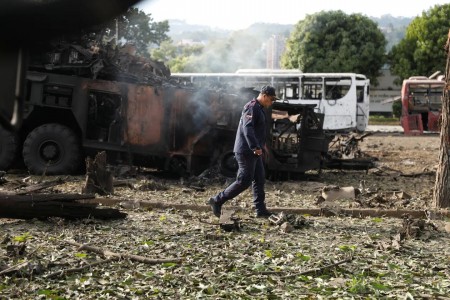 A destroyed antiaircraft unit after the United States attacked Venezuela, Caracas, January 2026
Leonardo Fernandez Viloria / Reuters Early in the morning of January 3, U.S. forces struck Caracas, seized Venezuelan President Nicolás Maduro and his wife, and flew them out of the country. The extraction operation caps off months of military pressure by the United States against Maduro’s regime. Maduro will be detained in New York City, where he faces federal drug and weapons charges. In a press conference Saturday, U.S. President Donald Trump said he is willing to attack Venezuela again and that Washington would indefinitely “run the country.”
For insight into what this means for Venezuela, the United States, and the region, Foreign Affairs spoke with Francisco Rodríguez, who served as the head of the Economic and Financial Advisory of the Venezuelan National Assembly from 2000 to 2004. Rodríguez also served as Head of the Research Team of the United Nations’ Human Development Report Office from 2008 to 2011 and as Chief Andean Economist at Bank of America from 2011 to 2016. He is the author of three books on Venezuela and is now a Senior Research Fellow at the Center for Economic and Policy Research and a professor at the University of Denver. Rodríguez spoke with Senior Editor Daniel Block on Saturday afternoon. The conversation has been edited for length and clarity.
What is the current political situation in Venezuela?
The structure of the Venezuelan government that was set up by Maduro is still in power. His regime still controls the military. It controls the security forces. His vice president, Delcy Rodríguez, has succeeded him in office. What has happened, in other words, is very similar to what happens when there’s an assassination of a political leader. You take out the head, but the structure continues to be in control.
.
Now, whether this structure lasts is uncertain. In his press conference on Saturday, Trump effectively signaled that he will carry out another military operation if Rodríguez doesn't collaborate with the United States. Trump wants Washington to run the country, so my guess is that he sets up some kind of team to exercise influence over Venezuela and asks the Venezuelan government to meet their various demands.
Can the Venezuelan government really accept that kind of arrangement?
There will certainly be a section of the government that says, "We’re going to resist.” But the United States has proven that its military threats are credible. And Trump’s demands might actually be more tolerable to Rodríguez than they initially appear. When he says that Washington is going “to run the country,” he is likely talking most about getting U.S. companies back in and having the United States take control of Venezuela’s oil. Rodríguez could deliver on that. In fact, Maduro tried to make such an agreement in 2025. He made an overture to Trump where he effectively said, "You can have whatever you want in terms of our oil industry."
Trump, of course, didn’t accept that from Maduro. Why might he be willing to work with Rodríguez on a similar arrangement?
Francisco Rodríguez
Maduro had become utterly toxic—the embodiment of an evil dictator. What Trump seems to be saying now is that he’s willing to do this with a post-Maduro government, even if it’s led by Maduro’s own people. I found it interesting that the United States had such an easy time capturing Maduro and his wife while they slept. That strongly suggests that there was some type of internal collaboration from the Venezuelan forces that were guarding him. It doesn’t mean that the whole regime betrayed Maduro. But it does suggest this could have been something of a palace coup. [Secretary of State] Marco Rubio is already having conversations with Rodríguez, and Trump said that he thinks Rodríguez is ready to do what it takes to, in Trump’s words, “make Venezuela great again.” And surprisingly, Trump said that María Corina Machado—the opposition leader who was behind Maduro’s electoral defeat last year—doesn’t have the respect necessary to lead the country. So Trump seems to think he can work with Venezuela’s current government to meet U.S. demands in terms of oil security and national security.
That said, the regime might not be willing to meet Trump’s demands. There are other government officials who could push against any kind of accommodation. In that case, Trump might decide he has no choice but to increase the pressure with more military strikes and, ultimately, a land invasion. Trump has clearly invested a lot in this operation, and he’s now claiming it’s a huge success. It’s hard to see the president backing down if he doesn’t get control of the oil industry. I think that no matter what, we’re going to get a scenario in which American companies are going to be running the Venezuelan oil industry as if it were a United States protectorate.
Let’s say that’s what happens: Caracas continues to resist and there is an invasion. What do you think would happen?
I think that what we saw this weekend indicates that a land invasion of Venezuela might not be that difficult for the United States, militarily speaking. The Venezuelan armed forces didn’t prove capable of resisting or creating any real danger to U.S. forces. But that doesn’t mean that occupying the country is going to be easy. Venezuela has a large landmass, a large population, and many active paramilitary and criminal groups. It’s a place that could easily fall into anarchy. You can imagine a world where Washington takes down the state, only for elements of the Venezuelan army to form a guerrilla movement together with some of the Colombian guerrilla groups already active in the country. You could easily end up with a civil war–type situation.
How do you think Venezuelans feel about Washington’s operations?
First, I don’t think that the United States going into another country and kidnapping its leader, however evil that leader may be, is a good outcome. I don’t think that's a good policy strategy. It undermines some of the basic rules that govern relations between countries and therefore makes the world more dangerous.
That said, Venezuelans disliked Maduro, and most of them are probably happy to see him go. We’ve already seen some spontaneous signs of people celebrating his ouster. Now, the situation is very tense because, yes, Maduro is out, but his regime is still in power, and it’s important to remember that Maduro has loyal supporters. But Venezuelans have gone through a horrible crisis. The country has lost nearly three-quarters of its GDP. Eight million Venezuelans have fled. So I think that the majority of Venezuelans are tired and want a way out, and an overwhelming majority are going to welcome the closing of this chapter.
Is it possible that Venezuela could transition to democracy?
That depends on what we mean by democracy. I have no doubt that any government that oversees an economic recovery could win Venezuelan elections. And there’s a world in which Venezuela now gets such a recovery. If the state gets oil production back up, which is possible with U.S. support and the lifting of sanctions, Venezuela could experience high, double-digit growth for several years. My estimates, which coincide with those of other economists, including those who work for Machado, is that Venezuela could see its GDP per capita in U.S. dollars triple in the next decade. So if the Venezuelan government strikes a deal with the United States that lifts sanctions and where billions of dollars go into recovering the Venezuelan oil industry, whatever government is in power could comfortably win free elections.
But that doesn’t mean Venezuela would then be a genuine democracy. It’s easy for governments to hold elections if they know they’re going to win because the economy is doing well. True democracy requires a situation where elections are not held merely when it’s convenient for incumbents—and that’s a higher bar. It means a system of government where power can and does transfer between opposing parties in response to the will of the citizens. And I am not optimistic that we will get that. Instead, we will probably get a situation where the government, whether it’s headed by Rodríguez or Machado or some other figure, is essentially subservient to the United States. We will have the United States, through military might, determining who is in charge.
Let’s talk about Venezuela’s opposition. Various opposition leaders asked for the United States to intervene. Now, it has. But as you noted earlier, Trump said he doesn’t think that Machado has the respect needed to lead. What options do she and her movement have?
Machado was really dependent on the United States. She did not have the support of an insurrectionist force or rebel fighters that were ready to take power. She had the support of the majority of Venezuelans, but that support was, more than anything else, opposition to Maduro. What she had was Washington, and Trump has pulled the rug from under her.
Now, Machado and the opposition can try to prepare for when Venezuela next has elections. But that could take a long time, because again, Trump was not talking about elections. He was talking about the United States running the country until it’s stabilized. So aside from continuing to advocate for the Venezuelan constitution to be respected and for the result of the elections to be honored or to have new elections and compete in them, Machado and the opposition don’t have many options.
How do you think the other countries are going to react to Washington’s actions?
We’ve seen some statements, and along predictable ideological lines. We have seen some expressions of support from center-right and right-wing leaders. We’ve seen obviously strong condemnation from leftist governments like that of Cuba. But we’ve also seen center-left governments condemn U.S. actions, such as Brazilian President Luiz Inácio Lula da Silva and outgoing Chilean President Gabriel Boric- even though Boric has been a Maduro critic. This attack cuts so strongly against the basic idea of self-determination that I think it’s going to spark a significant amount of rejection.
Now, that said, leaders in the region and around the world know they know that they have to be careful about not antagonizing Trump. They’re trying to solve their own problems, including their own bilateral problems with the United States. They know that if you get on Trump’s bad side, Washington might decide that it’s going to impose tariffs on you or not cut that trade deal on which you were working. So we're also going to get some responses like what we’ve gotten from the European Union and some European governments this morning, which are muted and couched in diplomatic language.
What do you think the United States should do going forward to help Venezuela, now that Maduro is gone? Is there any reason to be optimistic?
There is an element of prudence in Trump saying that the opposition cannot currently run the country. Machado and her allies have advocated for imprisoning almost all of the Venezuelan military and political leadership. So I think if Trump were to simply install Machado, the risk would be ungovernability and chaos. It could also be a pathway to civil war, as ousted current military officers fight back against the government rather than risk going to prison.
Instead, and as I argued in my Foreign Affairs piece, what the United States should do is foster some type of agreement between the new leader [Rodríguez] and the opposition that results in a power-sharing agreement, where they build institutions for coexistence. Trump suggested during his press conference that there would need to be a period of time before there could be a proper transition. And I think there’s a kernel of truth to this, which is that holding new elections too soon may create more problems than it solves. If Rodríguez and the U.S. government use the upcoming months to build systems that regulate competition and protect those who lose elections, that would be a much more solid basis for a durable democratic transition in Venezuela.
But this kind of positive outcome very rarely happens as a result of military action. External state building usually results in instability. And Trump seems to be framing this attack not around democracy, but around oil. That is a serious mistake. Demanding that Venezuela hand over its oil resources to the United States is going to generate huge levels of animosity in Venezuelan society. It could even leave Venezuela’s opposition really disaffected—particularly if Washington partners with Rodríguez and doesn’t press for any political reforms within the country. The opposition hoped to drive Venezuela’s autocrats from power and gain freedom and autonomy for the Venezuelan people. Now, they might end up with a system where Maduro’s regime is still in control, and it’s struck an oil deal with the United States. It is the antithesis of what they wanted.



 FAQ
FAQ Search
 Login
Login
