It's risky business to evoke the Eighties youth pictures
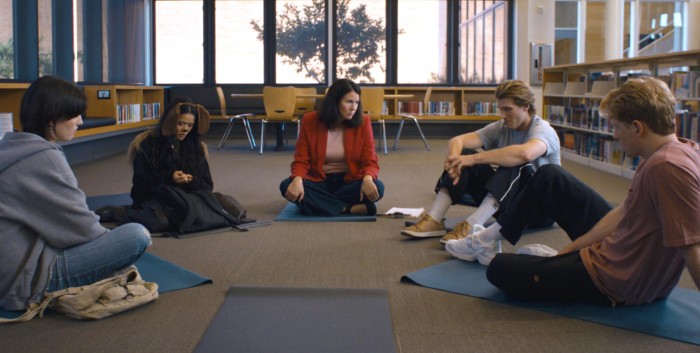
Even though, wisely, this is'n't called The Breakfast Club II, it must invite comparison with the 1985 John Hughes classic with Judd Nelson, Molly Ringwald, Emilio Estevez, Ally Sheedy, and Anthony Michael Hall. The premise is the same and the homage is reportredly intended. At this new Saturday punishment session at a high school that, instead of Chicago, is in Bainbridge Island, near Seattle, one of the five miscreants hasn't showed up so we'e left with a smaller cast. Instead of a hostile male teacher a slightly odd psychotherapist with a British accent called Dr. Messerschmitt (co-director Emma Cameron) is in charge. The decision has been made to improve, not punish. In fact, the kids beg to have regular detention, and skip the group therapy, and we, as spectators, may agree. This device seems only to get in the way of the kids' revealing themselves. Maybe viewers will find this more contemporary. They will not necessarily be as well entertained.
The same trajectory is followed. In both films the kids reveal vulnerabilities, bond, and split feeling better at the end. Maybe the four 21st century kids, with their supposedly more complicated, hidden vulnerabilities., are of this age and different from the John Hughes kids in a necessary way. But John Hughes was a classic writer and director, and the Eighties when he worked was a high point for youth pictures. We are not in such a good period for the genre now.
In The Breakfast Club, the five are stereotypes: spoiled rich girl prom queen, weird girl, the sensitive nerd, the wrestler jock, the defiant bad boy. They bond so sensitively four have paired off into couples at the end, and the bad boy gets the prom queen. They've admitted that, though it's wrong to be that way, as the spoiled rich girl explains they are likely to go back to ignoring each other when school begins again.
Both films vie with each other in the absurdity of the disobedience they get away with, even more so this time, though in 1985, in a key moment late in the film, the five nab the bad boy's stash from his locker and all get high on pot. It's when they're high that they really open up with each other. They don't need a therapist. And in fact they share more deeply and more touchingly on a little weed than the contemporary group does with the therapist. The Camerons have abandoned the feel of an actual detention session, and not found anything satisfying to replace it. The little exercises "Dr. Messerschmitt" (Emma Cameron) gives the kids to do have less psychological depth and emotional interest than the John Highes' pot session.
This time the weird girl is weirder, but the idea of a changed appearance carries over. Ally Sheedy gets a makeup do-over by Molly Ringwald's glam girl, and the beauty it brings out stuns Emilio Estevez's wrestler jock. This time the weirder girl, Mary Beth (Anna Mulia) is made up to look like a dog but drops that, and emerges, she too, as a beauty.
Dr. Messerschmitt gives the four a series of conventional psychological games to play, like falling backwards into someone's arms, passing on wishes, sharing secret dreams. Tensions grow and disperse between the four young people. Strangely, when they're given a short time for lunch and warned they'll be locked into further sessions if they're late, they go off in a car for it, and have to rush back. There winds up being less meat in this new version. The new film stars Ricky Spaulding (as Corey), Bianca Mariani (as Eden), Ian S. Peterson (as Nash), Anna Mulia (as Mary Beth), Elizabeth Mitchell (as Grace), and the aforementioned Emma Cameron as Dr. Messerschmidt. ThE four main young actors, playing Gen Z, get a chance to strut their stuff. You can watch this online, go back and rewatch The Breakfast Club, and see what you think.
It is interesting and rather disconcerting that in neither film do the kids talk about their teachers, or about any of their classes, or about college prospects. This is a dead end and they see no way out. Or maybe it's just that the filmmakers didn't see the kids all the way around.
Detention, 83 mins., was released in the US Aug. 1, 2026. Available on demand Oct. 22.