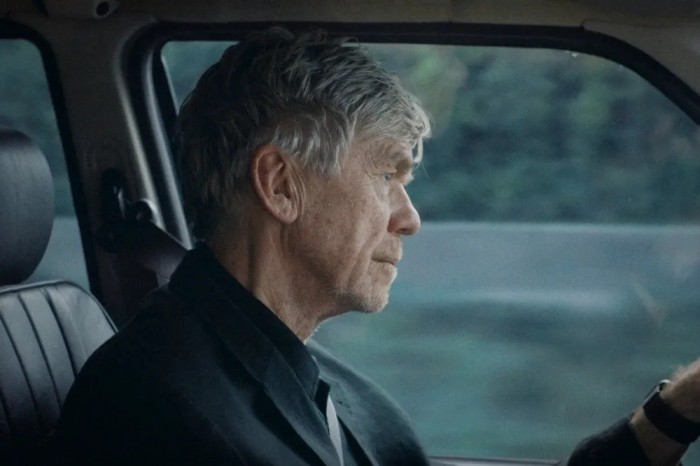
BOBBY SOMMER IN LONDON
Autobahn revelations
A road movie, though it was shot in a studio, which somewhat deflates its balloon. Bobby (Bobby Sommer) a rideshare driver, is a neutral man with a full, tidy head of white-gray hair, and he is on the road, frequently driving back and forth between Salzburg and Vienna on a famous highway that has some features remaining from the Nazi era, going to visit his friend Arthur in a hospital bed. Mostly German is spoken, though a couple of times it's English, and one woman speaks only Romanian. Don't worry about London: see it just as a symbol of a place where somebody wanted to go once, a gesture toward the freedom of the autobahn.
Leo Barraclough describes a few of the riders in his Variety review: "the soldier questioning what it means to fight; the supermarket trainee heading to see family; the academic looking at the history of the highway; and the queer woman about to get married. Different paths, different accents, different stories, most of them true."
There are ten different rideshare passengers, half men and half women, who Bobby takes along for all or part of the journey, including filmmaker TEd Fendt as an academic. The result of the road movie format is desultory conversation, by design. The conversation was improvised, with Sommer getting some tips about subject matter via earbud. The result is a documentary hybrid. You can say it is terribly random and uninteresting. You can say it's deeply emotional, and adds up to a panoramic portrait of Europe. Take your pick. If Bobby Sommer seems familiar to you, you may be remembering Jem Cohen's wonderfully atmospheric film Museum Hours, , where he plays a guard a Vienna's famous Kunsthistorisches Museum, talking on and on to people about the art. In fact this Bobby too is a museum guard, but retired now.
Someone was in a coma in Museum Hours, too. But the beauty of this film is how it patiently delineates the slowly emerging shape of conversations on the road. Most of the action takes place inside a car, with Bobby at the wheel, the way details about each speaker emerge, bit by bit, sometimes with the sudden revelation of something deeply felt. Chief among these is Bobby's semi-submerged love of the man he is coming back and forth to visit in the hospital where he is in a coma, someone from whom he was separated for a long time, but the thought of whom makes him involuntarily weep.
The whole experience is of something seemingly dull and numb, the numbness hiding something raw and unprotected, revelations of the inexplicable variety of the secrets of the road.
It's a terrific idea, and a very human one. There is not any singler complicated story behind it - the writer is more interested in situations than narratives. Still, we viewers are left with the sense of an experience, perhaps memories of our own times on the road, the awareness of what intense feelings we ourselves may have taken along with us for a ride there: memories of desire, possibliity, trauma, hurt, disappointment, relief. All the passengers have their particular stories. Bobby is like a shapeless old shoe into which many different feet can fit. His reactions are quiet, neutral, nods of the head. But then he tells his own story, and it's about his youth, about aging, about loyalty to a sick friend; and a story of twentieth-century Europe.
London, 122 mins., premiered at the Berlinale Feb. 2026; also Thessaloniki,Toronto, Leipsig, New York (Sept. 26, 27, in the Currents section of this year's NYFF.