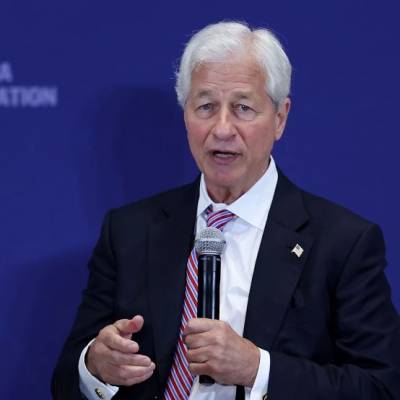
JAMIE DIMON
WSJ Opinion
Jamie Dimon: A Plan for the Western World’s Revival
A U.S. trade pact with Europe could encompass friendly democracies and revive the old alliance.
By Jamie Dimon
Sept. 28, 2026 4:57 pm ET
Political Economics: Europe trails far behind U.S. economic output. Politics is bound to catch up sooner or later. Photo: Storyblocks
I never want to read a book with the title “2050: How the West Was Lost.” The story might begin around the millennium, amid the West’s deteriorating military capabilities and economic fragmentation due to our inability to execute strategic policy. But we still have time to write a different story.
A renewed commitment to American values and alliances coupled with bold reforms by Europe would be a geopolitical and economic home run, guaranteeing the Western world’s strength for the next 250 years.
America still remains a global beacon of freedom and hope. Billions of people would move here if they could because of our opportunities. And if global investors could invest in only one country, it would be the U.S.
America’s global leadership rests on three pillars. If any one of them fails, it could doom the whole enterprise. The first pillar is maintaining the world’s pre-eminent military. The second is remaining the world’s pre-eminent economy, which is foundational to having the pre-eminent military. (The U.S. dollar’s role as the global reserve currency depends on both pillars.) The third pillar is reinvigorating the American dream and American values, which are weakening for too many of our fellow citizens. We must rededicate ourselves to the values and principles that made this nation great, including free enterprise.
To remain the pre-eminent global economy, the U.S. must improve its domestic economic policy. We should strive to grow 3% a year. If we had done this over the past 20 years or so, our gross domestic product per person would be $20,000 higher. Scores of federal, state and local rules and policies impede growth. Many of them can be reformed at no cost. But I will focus my attention on strategic foreign economic policy.
Since World War II, America has fostered economic and military relations, trading with more than 100 nations and forming more than 50 military alliances. The levers to accomplish our foreign-policy goals include trade policy, through tariffs, quotas, investment policies, regulatory barriers and other instruments. Another lever is industrial policy, which encompasses subsidized loans, tax rules, export credits, immigration policies, government investment and development finance.
We need to exercise all these tools to protect national security and resiliency. Foreign economic policy should maximize growth and competitiveness, both in the U.S. and for American companies doing business internationally. This would strengthen our allies economically and bind them closer to the U.S. and like-minded Western democracies. If the economic and military bonds among the world’s democracies weaken, there could be negative consequences for America. Our adversaries want to see our allies far less dependent on the U.S. and far more dependent on them.
Institutions that helped undergird the peace and prosperity of the past 75 years, such as the United Nations, the North Atlantic Treaty Organization, the World Bank and the International Monetary Fund, need reform. Some are reforming but any changes should bring the U.S. and its partners closer together, not drive them apart.
Many countries talk about a coalition of “middle powers” for military and economic purposes. In many ways, such a coalition already exists: Europe. Unfortunately, the Continent has been declining militarily and economically for decades. Europe and the U.S. share deeply held values and the Continent is still America’s largest trading and investment partner. But Europe relies on imports for nearly 60% of its energy, has a disjointed defense industrial base, faces a manufacturing threat from China, and has a tangle of rules that hamstring capital formation and technology innovation. If this continues, Europe will be in the dire position of failing to meet its military and social needs.
It is in America’s interest that Europe succeed. But as recent years have shown, the old trans-Atlantic bargain is breaking. That doesn’t mean the trans-Atlantic relationship has to. For decades, the bargain was straightforward: The U.S. provided the backbone of European security, Europe largely accepted American leadership, and both sides believed the arrangement served their national interests. The status quo is being renegotiated. Europe’s weakness has led many in the U.S., often for good reason, to be hostile toward the Continent. And many in Europe react to tariffs and other policies with hostility toward Washington. We are in a vicious circle.
Europe is being asked to shoulder more of its own defense (and that of the Arctic) while simultaneously facing a competitiveness challenge from China. A Europe that can mobilize capital, scale innovative companies, consolidate defense production, reduce strategic dependencies and generate stronger growth would be a more capable security partner, a more resilient economic partner and a stronger counterweight to Beijing’s economic power.
To succeed, the Europeans must reform how their economy functions. They know what to do, which is to adopt the more than 300 recommendations in two 2024 reports, one by Enrico Letta and the other by Mario Draghi, both academics and former Italian prime ministers. Yet so far, fewer than 16% of the reforms have been implemented, tipping Europe into the “slow agony” of decline Mr. Draghi warned about.
If the European Union strengthened its internal market structure by completing the Capital Markets Union and Banking Union, it would transform the Continent’s ability to scale and compete. A more integrated financial system would unlock investment for strategic industries, enhance stability and reduce fragmentation costs. It would enable more European banks to compete globally and make the Continent a more attractive environment for foreign firms.
This is the moment for bold ideas, and I believe the U.S. should offer Europe a major inducement: If it executes meaningful economic and military reforms, including everything that we consider crucial for security and resiliency, the U.S. will negotiate one big, beautiful economic and free-trade agreement with Europe. Many of the current disputes between Europe and the U.S. are minor compared with this agreement’s size and benefits. This pact could be extended to friendly democracies including Canada, Mexico, Japan, South Korea, Australia and the Philippines.
It would be an economic and geopolitical game changer for the U.S., Europe and our other allies. It would allow us to set the global rules on trade and would bind Western allies together in the face of autocratic pressure.
This is a long shot, and it has been tried before. In the 2010s, the U.S. and its allies almost accomplished this with the nearly finalized Trans-Pacific Partnership—a trade pact with 12 Pacific Rim economies including Japan, Canada and Australia. We should resurrect that agreement as well as the Transatlantic Trade and Investment Partnership between the EU and the U.S. This would create economic growth among all member nations and protect them from mercantilist behavior by China or others.
Those pacts were derailed because politics moved against free trade, amid fears of lost jobs, lower wages and business displacement. Such concerns are valid. Too many efforts to help those most affected by trade deals fell short. Therefore, we must match this big idea with equally bold steps to help affected workers or businesses. The American dream should work for everyone, and Washington and the private sector must step up to meet the moment.
The world is very different from 10 or 20 years ago. The risks today are enormous and the stakes couldn’t be higher. A strong America with robust military and economic alliances is the foundation for a prosperous and peaceful world. Let’s write a new book, “2050: How the West Regained Its Mojo.”
Mr. Dimon is chairman and CEO of JPMorganChase.
_________________________________________________
Paul Krugman's comment on this column:
A Globalist Comeback?
Hints of a business break with MAGA
Paul Krugman
https://paulkrugman.substack.com/p/a-globalist-comeback
Transcript
On September 28th Jamie Dimon, CEO of JPMorgan Chase, one of the most prominent, most successful financial figures in the United States, published an article in the Wall Street Journal titled, “The Hell with Trump, Let’s Go Back to Globalism.”
Okay, that’s a lie. That wasn’t what the article was titled, but it was, in effect, what it said.
And it was a very interesting message to be coming at this moment in time. I think Dimon’s op-ed can be viewed as a harbinger of a big shift in the business community’s political positions and its attitudes that may be coming in the very near future — in effect a bet that Trump and MAGA in general are going to be in the rearview mirror, not too far from now.
Now, a word about Dimon. He’s an extraordinarily successful financial leader. He navigated the 2008 financial crisis and aftermath better than almost anyone else in Wall Street. He had the good sense to limit JP Morgan’s exposure to the practices that helped to create that financial crisis.
He is also a very, very smart political operator. He has had a talent for not making enemies, for staying at least on decent relationships with administrations from both parties, which is no mean feat in 21st century America. He certainly did not join the cavalcade of business leaders rushing to prostrate themselves at Trump’s feet after the 2024 election, and yet he was subtle enough about his restraint to not get put on Trump’s enemies list. So,you know, his political judgment should be trusted.
His economic judgment, all right, being a great businessman is not at all the same thing as being a great economist. And there’s no particular reason to think that he is always right about economic affairs. But that is, in a way, mostly beside the point.
So what did Dimon call for? Well, he basically said, we need to repair theWestern alliance. We need to bring the Western world, the advanced democracies, above all the United States and Europe, back together in part as a way to stand up against the threat of a rising China. And his proposal for how to do that was to negotiate a free trade agreement between the United States and the European Union.
That’s quite something. That’s a very un-MAGA position to take. You want to bear in mind that, first of all, we’re currently under a government of people who do not at all believe in the virtues of free trade. In fact, are extremely hostile to globalism. Certainly don’t believe in binding international agreements. Maybe they want agreements that bind other countries, but not them.
And they are also not of the mind that we have a lot of shared values with the democratic governments of Europe. The MAGA position, if anything, is that they like the anti-democratic forces in Europe. J.D. Vance essentially campaigned for Viktor Orban in Hungary. Trump officials have been quite clear that they have sympathy for the AfD in Germany. So if we have common values with some Europeans, the Europeans with whom they have common values are neo-Nazis. And Trump’s de facto support for Putin in his invasion of Ukraine has been alarmingly clear over the past two years.
What we’re seeing here is Jamie Dimon basically saying that I don’t care about any of that. I don’t believe that you people are going to be in charge. And I think that we can go back to trying to rebuild bridges to Western Europe.
Now, it’s kind of interesting the way he phrases it. He puts a lot of it in terms that I suspect are intended to appeal to economic conservatives in the United States who are not MAGA types. He sells his proposal in part as an incentive for Europe to conduct pro-business, pro-economic reforms. He cites the Draghi report on European Competitiveness, which has been very influential in Europe. And points to him for even knowing about it! There are probably not a lot of people in the United States who have read the Draghi Report, absorbed its lessons.
I myself have read it. I have had some criticisms of some of the analysis in the Draghi Report, but the reforms that Draghi proposes, which have a lot to do with completing the European internal market, making the capital markets in Europe more flexible and responsive and so on, are very much in the right direction. So this is a good thing. And I’m glad to see someone in the United States, someone prominent, actually taking European affairs seriously and wanting the Europeans to do things that will improve their own position.
Dimon is almost surely overstating how important a free trade agreement with the United States could be. The reality is that the obstacles to European reform are internal — as are the obstacles to all the reforms we should be making here. Politics is real on both sides of the Atlantic.
And we are not as important to Europe — or they to us — as a lot of people imagine. The fact of the matter is that Europe only exports around 3% of what it produces to the US. And we were pretty close to free trade with Europe until Trump II came along. We had our average tariffs of only something on the order of 2% on European products. So it’s not as if he’s actually offering a tremendous benefit to Europe, something that would radically dislocate their internal politics and move them in a positive direction.
But, all right, it’s a good proposal. And I think that, as I understand it, Dimon believes that the process of negotiating towards a free trade agreement would in itself help to improve politics. That it would be a signal that the ultra-nationalist, anti-democratic, often anti-European policies of theTrump era are behind us.
So he’s looking forward to the day when we can start to try to repair some of the immense damage that has been done to our international relations during the Trump years.
Dimon is a smart political operator. I’m reasonably sure he would not have written this op-ed if the polls weren’t pointing towards a Democratic blowout. And of course, he could be wrong in believing that that’s going to happen, as we all could. But I’m sure that he is looking at the situation and envisaging a Democratic Congress — almost surely the House and quite likely the Senate — after the November election.
And a reasonable president, not necessarily a Democrat, but most likely, but in any case a reasonable president after Trump has gone from the scene.And a president and Congress that would be interested in trying to rebuild the Western alliance. Because ultimately, although Dimon’s proposal is economic in the narrow sense, it’s really political. It’s about rebuilding an alliance.
That won’t be easy. The fact of the matter is that the United States did just casually rip up solemnly signed trade agreements. Almost everything that Trump has done on tariffs is a violation of agreements made over several generations. Also, it’s not just Trump. The American people elected Trump twice, and the rest of the world is not going to forget that.
But free trade agreements can be a way of not just of enhancing trade, which is important, but maybe not as important as economists would like to think. But they can also be a way of binding countries closer together. They can be a gesture of alliance. And Diamond obviously thinks that this is possible, or at least thinks that it might be possible — close enough to being something that would really be on the table, that it’s worth making a case for it, and that it’s worth positioning himself and his institution for a post-MAGA era. And as Isaid, Diamond is a smart guy with a very, very good political judgment.
So that op-ed was one of the most encouraging things I’ve seen in months.
On that happy note, take care.