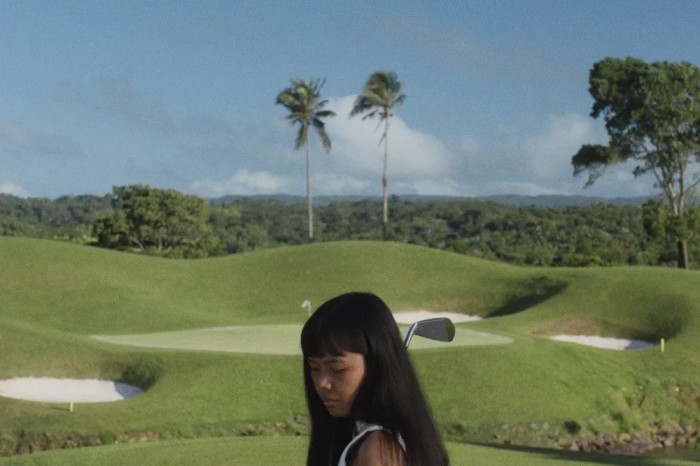
JORRYBELL AGOTO IN FILIPIÑIANA
Stylized, slow-moving portrait of a posh Manila golf club
There is much to be admired pictorially in the film Filipiñana, and one may also enjoy its ritual, musical quality. The square format seems to invite scrutiny of the opening landscape panoramas of a beautiful grassy, tree lined expanse that are exquisitely framed and photographed by dp Xenia Patricia. But only the devoutly masochistic festival-goer is likely to accept without protest or a sense of rebellion the slim writing and passive-aggressive direction of writer and director Rafael Manuel. The self-conscious slowness and uneventfulness, and just how into itself this long-seeming 100-minute film is, are impossible to forget for a single self-conscious, arty minute.
And this is too bad because he wants to say something about colonialism and exploitation, about privilege and luxury, about exotic places, luxuries, and dark-skinned underdogs that may make you think of another slow-mover, Albert Serra's 2023 Pacifiction, which is about much the same things, and is a slow-mover too. But Serra's film is relaxed and improvisational. And it has Benoît Magimel (who got French Best Actor awards two years in row then) - and the film's detached sense of itself and the actor's sly self-parody lead into something enlightening and hypnotic. Filipiñana, in contrast, feels stiff and self-conscious in almost every frame, and this trivializes its important political and social message. Perhaps social criticism can't be quite this pretty.
With that warning, we can try to say what is going on here. A girl of seventeen called Isabel (the sad-faced Jorrybell Agoto) arrives at a very posh private gold course and club to work as a "tee girl." An exchange that stands out is one where someone asks a US visitor , Clara (Carmen Castellanos), who is here from New York hosted by her uncle, whether the caddies in America are female as here, and Clara replies that in America there are no caddies. She might have said "any more," for of course there used to be caddies, and it was a good job for young men learning golf. This is a world of overt class distinction, of service, and of servile women. And besides the older female caddies dressed in green uniforms, there are smaller or younger girls in blue outfits trimmed with white whose main job is to set up the balls on tees, which are lined up in rows for men's driving practice in hitting bays.
Is this the Philippines? Yes, of course, the title says so, and the girl protagonist, Isabel, is Ilocano, one of the large ethnolinguistic groups of the country. She is from the rural north, but the club president and director, Dr. Palanca (Teroy Guzman), also speaks Ilocano. Through the course of the film Isabel realizes that what they have in common in their background is ugly - bloody, exploitative land and labor practices—such as violent massacres of striking workers—upon which the elite country club's pristine golf course was built. Dr. Palanca is part of the exploiters of the poor and powerless, Isabel is one of the latter. Having girls lined up essentially cowering below rows of men whacking golf balls the girls set up on tees looks menacing and dangerous for the girls. Yer apparently this is not an invention of the film but an actual custom in the Philippines.
Jordan Mintzer's admiring Hollywood Reporter review of Filipiñana calls it "dark and surreal," and this is what it would like to be. But director Manuel is better at set-piece-style imagery than at creating a mood. The film needs magic realism, but has only arresting images. True, these visuals can make a big piece of cake look both enticing and disgusting. Moreover the ritual performances for guests by the golf club employees combine musical comedy and surrealism.
Through the course of the film, Isabel gets hold of a golf club Dr. Palanca has forgotten and carries it around, wanting to return it to him. Eventually someone informs her that Dr. Palanca often "loses" things intentionally. Whatever, the girl goes on a slow meandering errand to return the "wedge" iron to the director, and her "search" takes her through a pathway of learning dark truths.
Or that is the intention of Manuel's film. The foreground action tends to feel both far fetched and lacking in dramatic interest. The film seems likely to be remembered more for the pictorial beauty of its landscapes than for its surrealism or its social commentary. Overriding both are its punishingly slow pace and sometimes stiff dialogue and acting. Valedictorian his year at the London Film School, Manuel won a Silver Bear at the Berlinale in 2020 for the original 24-minute short film on which this longer version has been based. Expanded to four times that length, this feature film Filipiñana feels stretched. But the work has style and originality, Rafael Manuel's talent is evident, and he will be back.
Filipiñana, 100 mins., premiered at Sundance Jan. 2026 (Creative Vision award); also Berlin, Milwaukee, San Francisco (New Directors Awar), Sydney, Karlovy Vary, Melbourne. US theatrical release Aug. 28, 2026 at Film Forum in New York , Sept. 4 in San Francisco at the Roxie theater.