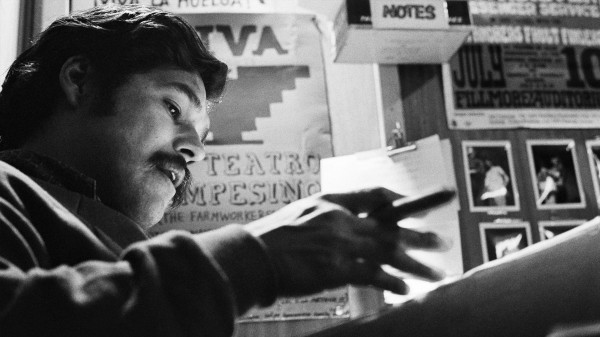
 LUIZ VALDEZ IN AMERICAN PACHUCO: THE LEGEND OF LUIS VALDEZ DAVID ALAVARADO: AMERICAN PACHUCO: THE LEGEND OF LUIS VALDEZ (2026) TRAILERLuis Valdez and the Chicano presence in America
 If they've been paying attention to social issues, older Californians of every stripe have heard of Luis Valdez and El Teatro Campesino. Everyone all over should hear of him now. Presently in his eighties, Valdez does most of the telling of his own story in this documentary being shown both in theaters and as part of the PBS American Masters series, and a unique and important story it is. He was born June 26, 1940 in a family of
campesinos, Chicano or Mexican American farm workers in Delano, California . He was to found an activist theater for the farm workers to wake them up to their plight and make them laugh. As he grew up ih the prosperity of the American 1950's, he found his community was not sharing in it. As Dolores Huerta, one of the key talking heads of this film, tells, the California farm workers in those days when Valdez was coming up were "slaves" - forced to work for minimal wages from sunrise to sunset, with no bathrooms or water provided.
Dolores Huerta is a renowned Mexican American labor leader and civil rights activist who co-founded the United Farm Workers (UFW) with Cesar Chavez. The UFW conducted a long and memorable strike, of grape farmers known simply as La Huelga, the strike, from 1965 to 1970 against sellers of non-union farm products. It grew to boycotts of big supermarkets selling scab grapes all over the US, spilling over to head lettuce and strawberries and focused also notably on the large Gallo winery, which utilized non-union grapes to make its generally cheap, mass produced wines, that boycott lasting to the late seventies.
Luis Valdez created a Teatro Campesino, a theater of the farmers and of the people, he explains, to depict the predicaments of La Raza, the Chicano people, for Chicano people. They had no funds and used minimal, improvised means - masks and signs around their necks explaining if they were "Padroncino," "Jefe" or "Patrón" (land owner), Bracero (manual laborer or field hand), etc. He used a deliberately rough improvisational style born of necessity he refers to with the Chicano word
rasquachi, which could be translated "funky." "Rasquachismo" is defined by resourcefulness, do-it-yourself ingenuity, and the ability to "make the most from the least" using whatever materials are on hand. This style led to independence. Valdes explains that when the Chicano farm workers union leader, Cesar Chavez, insisted that Teatro Campesino members set aside the theater to work full time on the Huelga, Valdez felt forced to detach the Teatro Campesino from the UFW.
The account of the Teatro's treatment of the Vietnam war is particularly striking. First of all it was tricky for the Union to approach the exploitation of Chicanos by the Army as cannon fodder, because to oppose the Vietnam war risked appearing "anti-American." But the Teatro Campesino, using Day of the Dead imagery, presented a powerful piece narrated by a masked figure of Death who explains how the young Mexican Americans were lured into the Army and sent to their deaths in a far away country full of people who looked like themselves for no explicable cause. They went to El Paso, Texas where the locals supported the war. By the end of their performance, Valdez recounts, the audience was absolutely silent, shaken by the message that the vivid theater piece had gotten across to them.
The Teatro Campesino began performing widely on college campuses, where the response was so enthusiastic they began to recruit students to join them. Valdez, long single, also found a lifelong partner, Lupe Trujillo-Valdez, a Chicana activist, actress, and costume designer. They had a theatrical, not a church, wedding. Valdez recounts the history of 1970, a year when Mexican Americans became self aware as Chicanos. 1970 was their biggest demonstration against the war in Los Angeles in 1970 , whichbecame a police riot, in the course of which Ruben Salazar, a notable Chicano journalist, was killed by a policeman in a bar. It was a period of better disillusionment. On the other hand, theTeatro Campesino grew into acceptance as full-fledged theater, helped by the involvement of international theater figure Peter Brook. Valdez's 1978 drama
Zoot Suit was a significant move toward working on a larger stage both literally and figuratively, a drama defining Mexican American identity and experience for the larger American audience.
Wearers of zoot suits were called "pachucos." "Pachuco" is a word of Caló slang, Caló being a hybrid of Mexican Spanish, English, and Spanish Romani elements developed in the Southwest in the 1930's and 1940's. Puchucos were Chicanos with style, children of farm workers moved to the city, turned cool dude, defining themselves by their large-cut suit coats and pegged, baggy trousers. They had been targeted by police wholesale following a killing in Los Angeles in the 1940's. Valdez's play /musical
Zoot Suit whose main character was called El Pachuco was loosely based on the actual Sleepy Lagoon murder case and the zoot suit riots of 1940s Los Angeles. Valdez found the unforgettable Edward James Olmos to play the key figure, El Pachuco, the narrator-storyteller of his drama. Olmos is a talking head here and also provides his inimitable voiceover for this film. A film version of
Zoot suit, written and directed by Luis Valdes with Olmos and Luis' brother Daniel in the cast, was made in 1981.
The play was a big hit in Los Angeles. Olmos shone. It did not seem to transplant well. It was bought to Broadway in March 1979 - Valdez had never been to New York - and put on in the Winter Garden and the opening was filled with celebrities (Leonard Bernstein is shown, Andy Warhol, Mick Jagger). But then, in what Olmos says was a tragedy for American theater, all but one of the nine New York newspaper drama critics panned the play. Valdez had had a bad feeling, a major panic attack before the opening. He thinks it was a mistake not to provide subtitles for the parts of the dialogue in
Caló dialect Angelenos had somehow taken in stride. One of the reviewers' greatest insults was to assume on the part of some of them that English was not Valdez' native language. The whole experience was a humiliation and a disappointment for Valdez after a previous high.
Valdez returned home saddened and traumatized. In response he reaffirmed to himself that he belonged in California. Thefilm of
Zoot Suit came out in 1981 and was a moderate financial success and is a lasting cultural influence. Valdez was to return triumphantly to the national consciousness in July 1987 with the wonderful, galvanizing film
La Bamba, with Lou Diamond Phillips as the meteorically risen, tragically fallen 17-year-old Latino American pop star Ritchie Valens. This doc recounts the making of
La Bamba,, a story as exciting as the movie itself. It was the hit of the summer and the song became a hit again.
In this as other things Luis notably collaborated with brother Danny Valdez (another major talking head), and he speaks of his long period of estrangement from their older brother, Frank, who turned away from his ethnic roots early on to try to become a mainstream American. Now he can recount a reconciliation, and Frank also is heard from. You can't lose your Chicano roots, it's suggested.
As Carlos Aguilar says in his
Variety review, this documentary is "standard in construction but lively in tone." While it "is explicitly celebratory," he adds, "its existence is inherently a political statement." Indeed,theree is a lot of politicfs and history here, and a lot for the viewer to process. I encountered many enlightening and stirring moments.
Also heard from: Cheech Marin, Lou Diamond Philips, Linda Ronstadt,
La Bamba producer Taylor Hackford.
American Pachuco: the Legend of Luis Valdez, 92 mins., premiered at Sundance Jan. 2026, receiving the Audience Award and the Festival Favorite Award. It aas also shown at DocNYC, Santa Barbara, Houston, Doclands, Full Frame (Durham NC), and San Antonio. It begins its theatrical run July 17 at Film Forum in New York. July 31 it will begin showing in Northern California, with a number of Q&As. Friday, July 31, 6:10 PM PST, at the Roxie Theater in San Francisco including Q&A with Luis Valdez and filmmaker David Alvarado moderated by Roberto Hernandez and celebrating the San Francisco Lowrider Council's 45th anniversary. Its PBS American Masters broadcast will be scheduled for fall 2026.



 FAQ
FAQ Search
 Login
Login
