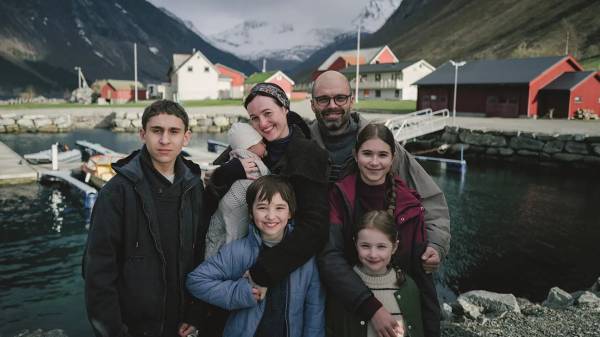
 FJORD (CRISTIAN MUNGIU), WINNER OF THE PALME D'ORCannes 2026 Awards
For an introduction to Cannes 2026 I refer you to my
Filmlleaf.net thread. Filmleaf was "attacked" and is still inaccessible for posting about Cannes but you can read that thread. My main source for the following was
The Hollywood Reporter's awards article of this morning. For attendee's live reports I recommend
The Oscar Expert's video made May 25 after Cole and Mason both got back from Cannes . If that leaves you hungry, you might try
Fish Jelly Film's' video in which 13-time Cannes veteran Joseph Robinson gives his 2026 Cannes worst and best lists with more details about each film.
Cristian Mungiu‘s
Fjord, the Romanian director’s English-language debut starring Renate Reinsve and Sebastian Stan as Romanian religious parents who relocate to a small Norwegian village and find themselves accused of child abuse, has won the
Palme d’Or at the 79th Cannes Film Festival.
With the win, Mungiu joins Cannes’ elite two-timer club, following his 2007 victory with
4 Months, 3 Weeks and 2 Days, his searing account of illegal abortion in Communist-era Romania.
For those keeping score, this marks the
seventh year running that
Neon has successfully picked the Palme winner. Tom Quinn’s indie outfit snatched up Fjord for domestic release ahead of this year’s festival.
At the press conference right after the ceremony, South Korean director Park Chan-wook, head of the 2026 competition jury, joked he didn’t want to give the Palme d’Or to anyone, “because it’s an award that I myself have never gotten.” Then, after a long pause, and referencing his last film, he landed the punch line. “But I had
No Other Choice.”
Andreï Zvyagintsev’s
Minotaur, a reworking of Chabrol’s
The Unfaithful Wife as an immaculate domestic thriller set against contemporary Russia, took Cannes’ runner-up prize, the Grand Prix. The film follows an executive who is required to sign over his employees to be cannon fodder for the Russian war effort in Ukraine. At the same time, he suspects his wife may be having an affair.
Zvyaginstev used his acceptance speech to call out Russian President Vladimir Putin and his war. “For millions of people, contact with art right now is about only one thing: That finally, the senseless killing of people would stop. And the only person who can stop this meat grinder is you, Mr. President of the Russian Federation. Put an end to this slaughter. The whole world is waiting for this.”
Best directing honors were shared between
Javier Calvo and Javier Ambrossi, the co-directors of Spanish musical drama
La Bola Negra, a García Lorca-inspired queer epic spanning eras with Penélope Cruz and Glenn Close, and
Paweł Pawlikowski for
Fatherland, a chilly, grief-laden film set in 1949 following novelist Thomas Mann (Hanns Zischler) and his daughter Erika (Sandra Hüller) returning to a fractured post-war Germany after years in American exile.
The best actor prize went to newcomers
Emmanuel Macchia and Valentin Campagne, who play the leads in Lukas Dhont’s
Coward, the WWI drama about queer love in the trenches.
Best actress honors were also shared, between French actress Virginie Efira and Japan’s Tao Okamoto, who play the leads in Ryusuke Hamaguchi’s emotional drama All of a Sudden. Both performers began to tear up when they took the stage to accept their acting Palme.
Emmanuel Marre won best screenplay for
A Man of His Time, his period drama, based on the life of his own great-grandfather, an author and engineer who chose to work for the fascist Vichy regime.
German director
Valeska Grisebach won the Jury Prize for
The Dreamed Adventure, a slow-burn thriller set in Bulgaria, that screened on the final day of the festival.
The Camera d’Or for best first film screening in the official selection, went to Ben’Imana from director Clémentine Dusabejambo, the first director from Rwanda to compete in Cannes. The film explores the pursuit of justice and reconciliation for survivors of the country’s genocide.
The ceremony began with a lifetime achievement award, an honorary Palme d’Or, for legend Barbra Streisand. Streisand, who is suffering from a knee injury, could not attend, but at her request, legendary French actress Isabelle Huppert paid tribute to her life and career. Huppert highlighted not only Streisand’s incredible achievements in film, music and on the stage but also her support for the LGBTQ+ community, and religious and ethnic minorities. Huppert’s speech was followed by a highlight reel of Streisand’s five plus decades in film, from
Funny Girl (1968) and
A Star is Born (1976) to
Yentl (1983) and
Meet the Fockers (2004).
Appearing via video, Streisand thanked the Cannes film festival “for this magnificent award.” She reminisced about watching her first foreign films at her local cinema, the Astor. “I was mesmerized by those images on the screen. They were so powerful that they are still in my head. I wanted to be an actress and live in those more interesting worlds.”
Recounting the highlights of her career, Streisand said being a woman and “an actress who wanted to direct” was a major obstacle, noting that it took 15 years to bring her passion project,
Yentl, to the screen. “But I had to make the movie,” she said. She ended with a celebration of cinema, saying film “has that magic ability to unite us and open up our hearts and minds. That is what we are celebrating in Cannes. Merci beaucoup pour cet honneur et vive le cinéma!”
Cannes has often proved a strong predictor for awards season. Several of last year’s winners, including Jafar Panahi’s
It Was Just an Accident, Joachim Trier’s
Sentimental Value, Kleber Mendonça Filho’s
The Secret Agent and Oliver Laxe’s
Sirāt, all received Oscar nominations, with
Sentimental Value winning the Academy Award for best international feature.
A full list of the 2026 Cannes award winners follows.
Palme d’OrFjord, dir. Cristian Mungiu
Grand PrixMinotaur, dir. Andreï Zvyagintsev
Jury PrizeThe Dreamed Adventure, dir. Valeska Grisebach
Best DirectorJavier Calvo, Javier Ambrossi, for
La Bola Negra; Paweł Pawlikowski for
FatherlandBest ScreenplayEmmanuel Marre for
A Man of His TimeBest ActressVirginie Efira, Tao Okamoto for
All of a Sudden, dir. Ryusuke Hamaguchi
Best ActorEmmanuel Macchia, Valentin Campagne for
Coward, dir. Lukas Dhont
Camera d’Or for Best First FilmBen’Imana, dir. Clémentine Dusabejambo
Palme d’Or for Best Short FilmPara Los Contincantes (To Opponents), dir. Federico Luis
Un Certain Regard Prize for Best FilmEverytime, Sandra Wollner
Un Certain Regard Jury PrizeElephants in the Fog, Abinash Bikram Shah (first film)
Un Certain Regard Special Jury PrizeIron Boy, Louis Clichy
Un Certain Regard Best ActorBradley Fiomona Dembeasset,
Congo Boy, dir. Rafiki Fariala
Un Certain Regard Best ActressMarina de Tavira, Daniela Marín Navarro, Mariangel Villegas,
Siempre Soy Tu Animal Materno, dir. Valentina Maurel



 FAQ
FAQ Search
 Login
Login
