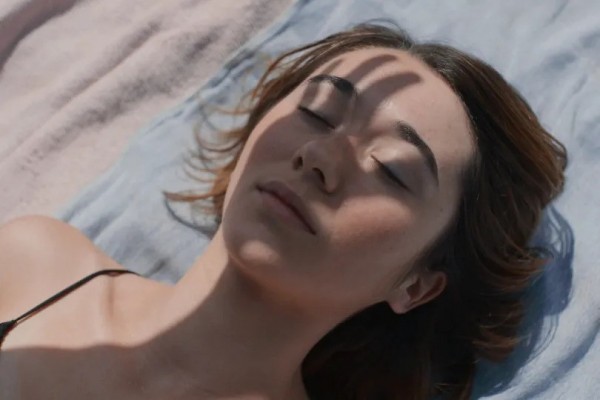
 ZOË STEIN IN FORASTERATRAILERHer grandmother's dress
Lucía Aleñar Iglesias is a Spanish film director who has been studying and working in the United States for almost ten years.
Forastera, presented at the 59th edition of
La Semaine de la Critique, (says their website) "is a journey back to her homeland told as a languishing fantasy, where family legacy is a matter of spirit possession, like a garment that would wear us as much as we wear it." In Iglesias' film
Forastera, Cata (the Barcelona-born Zoë Stein, excellent) is a 16-year-old who is on summer vacation (along with her younger sister Eva, played by Martina García, whom we rarely see) at the house on Mallorca where her grandmother and grandfather live, when one evening she discovers that her grandmother (Catarina, played by Marta Angelat) has fallen down the stairs and is dead. And then, in a sense, the film begins. The film is "about" what follows.
Forastera is beautiful, and simple; it has style just from the setting and the natural elegance of the characters that's very Mediterranean. The best moments in retrospect are those that come before the death of the
abuela, when everything seems simple and perfect but a little strange because it is so perfect. Clearly Cata does take on stabilizing the house (in itself so beautiful and full of light - and rather modern-seeming for her mother to have lived there as is supposed) after
abuela's passing. After the death, Cata's mother Pepa (Núria Prims) who comes from Madrid, creates discord. She assumes her father Tomeu (played by legendary Spanish actor Lluís Homar, still a handsome man at 69) is overwhelmed by grief and perhaps may need to be moved to a retirement home or assisted living, which angers Tomeu.
Cata also has an English-speaking boyfriend from Sweden, Max (Nonni Ardal Hammarström), whom we see a little more of than Eva. Even he has trouble talking about
abuela's death and he is more attractive furniture than a fully developed character. But I see this as studied simplicity, more than superficiality. The film moves along confidently enough.
The key segment is the one when Cata and Eva look at
abuela's rack of dresses, and their mother encourages them to try them on, saying they're in style again. But when she catches Cata wearing a particular dress that she likes - which fits her perfectly - with her grandfather, her mother gets angry because she thinks Cata is playing her grandmother to sooth her grandfather. Here for a moment one senses something strange. But the rhythm of swimming, walks, making out with Max, goes on normally, and Tomeu stops weeping. When Cata rushes back from a noisy village fair (with people in gypsy dress) nervous about having left her grandfather in the house alone, she finds him on a ladder in the kitchen repairing the fluorescent ceiling light, clearly quite in command of himself.
Mallorquí (Mallorcan) dialect is a form of Catalán, in which
forestera means a woman who isn't local and doesn't speak Mallorquí, an outlander. It is suggested that in stepping into her grandmother's role and being the stabilizing influence in the house of grief, Cata may feel like a stranger to herself, become someone else, or her future self. In an interview with the director in
Film Obsessive, it's pointed out that the director's dialogue embeds a layer of the "code switches" from Catalan to Spanish and back again throughout
Forastera that conveys her own experience with summer stays on Mallorca. So for Cata, there is role-playing just being here, but a familiar one. And one can be at home with strangeness.
And in a Mediterranean setting like this, it can all be simple and immaculate - as well as fundamentally beautiful - and, like the striking Mallorca sunsets, as Cata's mother remarks during one of them, is unique. There is a byplay between the conventional and the strange here that is subtle and lovely, special to the setting and the filmmaker's art, the simplicity perhaps helped by
Forastera having been expanded from a short film. Still, there may be unnecessary details. Why should Cata clash with both her mother and her grandfather over driving lessons? What is the point of Tomeu's getting stung by a jellyfish and talking about pee being the only treatment? But this remains a beautiful little film whose identity-inhabiting subject matter is treated with economy and subtlety. Lucía Aleñar Iglesias is a promising new voice.
Forastera, 97 mins., premiered at TIFF (Toronto) Sept. 5, 2025, chosen for the Discovery section and winning the FIPRESCI prize. It was also included at Valladolid, Tallinn, Stockholm, and other international festivals. US limited release by Grasshopper Film starting May 29, 2026 at Film Forum in New York followed by other cities. Film Forum,:Q&A with Filmmaker Lucía Aleñar Iglesias Fri. May 29, 2026,, 7:00 PM SHOW Moderated by Film Forum Premieres Programming Consultant Ruth Somalo. Sat. May 30 7 PM show moderated by journalist & critic Natalia Keogan
Metacritic 90%.



 FAQ
FAQ Search
 Login
Login
