 TRAILERAmbitious German film of generations and traumas
Mascha Schilinski's austerely magical saga
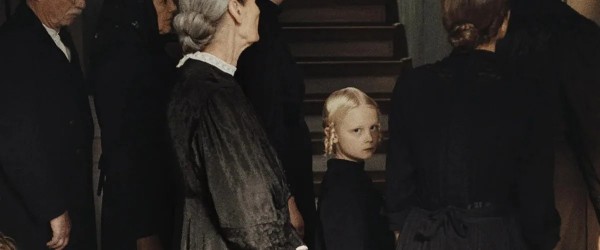
Sound of Falling (2025) covers over a century of German history, focusing on four distinct periods from the early 20th century to the present day. The film, which follows four generations of women, and four young women, Alma, Erika, Angelika, and Lenka, in the same Altmark farmhouse, primarily explores the 1910s, 1940s, 1980s, and the modern day.
Over an hour into this ambitious film a young man falls in a barn and from how he lands we can see a leg is seriously damaged. His groans and cries echo on and on. It's suggested that the leg must be amputated, and someone asks if the other will have to be amputated as well.
The film uses non-linear storytelling to weave together its four distinct time periods, and the trauma surrounding the leg injury acts as a focal point for the intergenerational suffering on the farm.
Is this the sound of falling? So much happens over so long a period of time, and one is left in a transcendently grim state of mind. Is life like this? Where is the real drama? Where are the successes and joys? Life has been reshuffled from an arbitrary point of view. But this is a brilliant and confident film.
Schilinski's vision and crfaft are consistently impressive, her scenes memorable. This is a film I've been hearing about since a year ago. Justin Jaeger, "Brother Bro" of "The Oscar Expert,"
speaking from Cannes 11 months ago, walking along as he filmed himself, spoke first about
Sound of Falling, saying its complexity led him to watch it twice, calling it "dense and complex," with "beautiful cinematography," with a "haunting tone," "very memorable as a tone piece, as a mood piece," and "ripe with layers of meaning." He described it as "a tapestry" whose meanings you can't pin down, a film that's "very abstract." He found it "amorphous" and "shapeless," but "impeccably well-crafted."
The film takes a while to establish period with people running around carrying candles; but the craft shows in an onrush of memorable moments. There is a girl walking along a body of water, who falls behind the adults, and has a fantasy of falling in and drowning. There is the image of a girl rolling down a hill into the water and splashing in. A boy is taunted in the barn, other kids yelling that he has a hard-on and daring him to stand up, to pull down his pants and show it. We are lost in the past, and it's a jolt when somebody sitting at a picnic table pulls out a cell phone she says she "inherited" from her mother.
Who can forget the young woman Lenka (Laeni Geiseler) who asks a man for a "ride to Glowisch," but won't tell him what she's going to do there. "Disco?" he asks. He lights a cigarette, tells her no, she won't get a ride from him. she says she will hitchhike. The genius of the film is in the specific, important feel of nearly every scene, even as we don't exactly know the significance of the moment, buried as it is in the particular demands of a situation peculiar to itself. Every scene matters in and for itself. "Brother Bro" reported in his fresh response from Cannes that this film "makes you see cinema as a language and art that can communicate in a way that others can't." Each scene has a crackle of specificity, and there is often even a recurrent literal crackling sound, like an old record turning on a turntable. Texture is a priority here, and a sense of foreboding.
A girl's voiceover says we can never know exactly what's going on because of point of view. "Mom knows things she shouldn't even remember because she wasn't even there when they happened," she says, meaning things such as how her sister Erika always stole uncle Fritz's crutches - a scene we have seen early on - "to see if she could walk with just one leg." And now we remember how in order to do this she tied her other leg up round and round with a cord go keep it out of the way. This over-and-overing of moments, different when revisited, helps explain why "Brother Bro" called the film "layered." It's really not so much complex as focused and richly crafted, as he said, building its narrowing yet decades-spanning scene-building texture.
Angelika, portrayed by Lena Urzendowsky, lives in the 1980's in the GDR East German era. In a memorable scene she watches a harvester machine cutting across a field of wheat carrying a flag over her shoulder and comes across a small animal the machine might run over and kill. In the WWII segment there is Erika, played by Lea Drinda, a young blonde woman with hair in buns who falls and laughs. She appears in the WWII-era segments engaging in strange, playful, and sometimes dangerous behavior while exploring the farm.
The huge farmhouse also is a character in itself and it changes radically through the century, winding up no longer in the same family's hands. And there are the servant's quarters, huddled around an inner courtyard, and, troubingly, we learn women servants are unwittingly sterilized. This brutal act is portrayed as a systemic practice designed to ensure the servants can work uninterrupted by pregnancy and to make them "safe for the men". Astonishing and disturbing and certainly like nothing else a sign that those were different times.
For all this Schilinski slips in and out of time, sliding with tricky camera shots into one period and back again to an earlier one. This certainly contributes to a sense of the complexity and interconnectedness of time, although my feeling is that this is a current fashion that may fade and tend to date a film in a future when it is remembered again that chronology is our friend, and it's realized that too much play with time distances us from events more than it clarifies them. Nonetheless, a remarkable film and one of the standouts of this year's Cannes. It has been compared to Michael Haneke's
White Ribbon but received even greater critical acclaim.
Sound of Falling can be hard going, but it's a must-see. An exceptional German film, and indeed one that you may rewatch, dipping in and out of scenes as the filmmaker dips in and out of time.
Sound of Falling/In die Sonne schauen ("Looking into the sun", 155 mins., premiered as a surprise Competition film at Cannes in May 2025 and shared the Jury Prize there with Oliver Laxe's
Sirāt. It was released in US theaters by MUBI on Jan. 16, 2026.
Metacritic rating: 90%. Available on MUBI and other platforms, including Amazon Prime.



 FAQ
FAQ Search
 Login
Login
