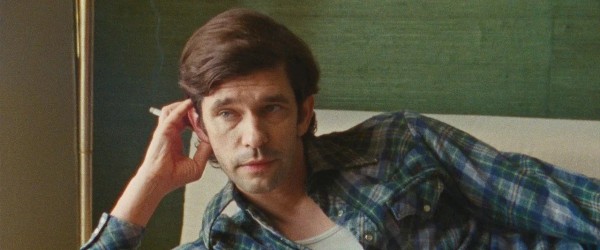
 BEN WHISHAW IN PETER HUJAR'S DAYRecreation of the mundane at an extraordinary time TRAILER
Perhaps seeing a good sample of Peter Hujar's photographs would detract from this film - which is about his day, not his work. If you read about him and see a selection (
The New Yorker provides
some) it's clear that he was good: his portraits achieve intimacy and authenticity even when not of someone he knew. But there are classic ones of Fran Lebowitz and of Susan Sontag, whom he knew well. Hujar was part of a Lower East Side 1970's New York City that was very exciting and alive. Fran Lebowitz has spoken of how that world, which was artistic New York at a time when New York was open and free to artists as never since, was decimated by AIDS. Hujar died of AIDS in New York in late 1987, three years after the moment of Hujar's "day." Catsoulis in her
TImes review says of this film that "ghosts of the celebrated and the gone-too-soon haunt every frame." Not all of this will be seen in this film and serious viewers should inform themselves of the background a bit. It will enrich the experience of watching it.
But most of all as the film explains at the outset it is the dramatization of a record. On December 19, 1974 Linda Rosenkranz recorded an interview with Peter Hujar "in which she asked him to recount in detail his activities of the day before." Let's remember James Joyce's
Ulysses: the account of a day can be an apic, it can parallel Homer. This is not that. This was to be one of a series but it was not completed and the recording was lost, but a typed transcript of the tape was found among Hujar's papers at the Morgan Library in New York in 2019. With the help of director Ira Sachs (whose
Passages, 2023 included Whishaw in the cast) and on the medium of Super 16mm film, Ben Whishaw and Rebecca Hall, using that discovered transcript as their script, have recreated this tape, which runs, as recreated, only slightly over an hour. They make it look like the tape started and stopped and ran through much of the day. Maybe it did. Anyway that provides visual variety as Peter and Linda move about different parts of Rosenkranz's attractive sunlit apartment, up on the rooftop, and back down, and a series of minor costume changes for Ben and many lightings and smokings of cigarettes by Peter, who lies down, sits up. shares a meal, and pours himself several whiskies.
Some viewers of this film have declared it to be profound and others have dismissed it as trivial time-wasting bullshit. It is neither. It is instead a new kind of narrative and performance that requires adjustment in the viewer. The slow, matter-of-fact unrolling of Hujar's narrative, so casually and naturally voiced by Ben, may somewhat evoke the famous definition of prose by the great but underknown English midcentury novelist Henry Green, which runs as follows: "Prose is not to be read aloud but to oneself alone at night, and it is not quick as poetry but rather a gathering web of insinuations which go further than names however shared can ever go. Prose should be a long intimacy between strangers with no direct appeal to what both may have known. It should slowly appeal to feelings unexpressed, it should in the end draw tears out of the stone ..."
But that's not really true here or if it is, it will be only later, in retrospect. There are no dramatic revelations or emotional climaxes in Peter Hujar's long monologue (with, of course, occasional interjections or questions from Linda Rosenkranz). If it is anything it is a "gathering web of insinuations." Hujar's long narrative is notable for its matter-of-factness. In the previous day he has gone not so far away to a worse part of the Lower East Side and a worse apartment, shabby and ugly, with linoleum flooring, where Allen Ginsberg and Peter Orlovsky live, to photograph Ginsberg for the
New York Times. It's just a thing he did. He admits to thinking of compiling a collection of photographs of famous people but it doesn't feel like this is really his style. From this brief account, you could make another movie of that Allen Ginsberg photo shoot. In fact Hujar seems to remember an awful lot of what he did on the previous day. Some of it isn't especially interesting, like working in his darkroom developing film and making enlargements of prints. Even, when you come down to it, his encounter with Ginsberg isn't very interesting, except that the minute-to-minute detail of it makes it come to life, like a movie.
It is interesting precisely for its matter-of-factness. That's the most striking aspect of it. After a while you may get bored. But there is gold hidden in the ordinary: think of Samuel Beckett. It is the unexamined life that is not worth living, even when the life examined may appear scarcely worth examining. Mostly it is important that in fact, Hujar appears to remember so many details of the previous day. He has been awake (despite two naps). We could do so well. This is about paying attention and about recall. It's an exercise, perhaps akin to Buddhist right attentiveness (which actually may be called "right mindfulness").
So even if you hate this film you may learn from it. One can see it partly as an exercise by Ben Whishaw, a triumphant one in which he enters so deeply into the mundane he may appear to be playing himself, and that would be his toughest role, mastered here. Some have thought this one of his finest performances. It creeps up on you, like the film itself. It recreates a moment like no other film, and the moment recreates, or rather tantalizingly suggests, a larger moment, as alluded to above, of Seventies artistic New York, which seems now almost like the Manhattan version of the Italian renaissance, a time when extraordinary things were easy and close at hand. When the extraordinary was ordinary and the ordinary was extraordinary.
Peter Hujar's Day, 76 mins., premiered at Sundance and the Berlinale in Jan. and Feb. 2025, showing at many other festivals including New York Sept. 27. Now a Janus Film available for subscribers of the Criterion Channel.
Metacritic rating: 82%.



 FAQ
FAQ Search
 Login
Login
