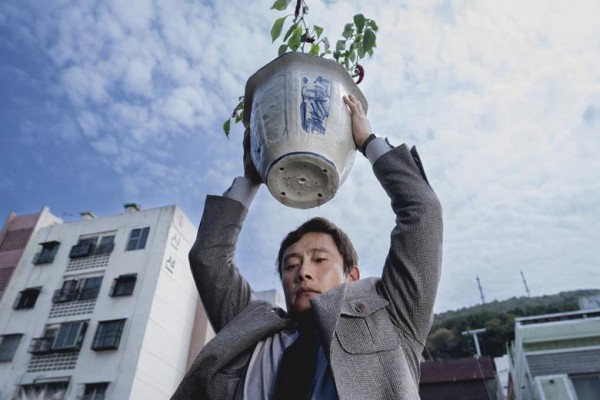
 LEE BYUNG-HUN AS MAN-SU IN NO OTHER CHOICEDownsized paper exec turns serial killer, take 3
 "Turbo-capitalism," as it's called in Costa Gavras'
Le Couperet aka
The Ax, refers to an overwhelming emphasis on profit over human need, which in turn leads to the human woes that arise from "restructuring" and "downsizing." This is the starting point of Donald E. Westlake's own favorite novel
The Ax (1997), on which both Costa Gavras'
Le Couperet and Park Chan-wook's latest film
No Other Choice are based. In Westlake's book despair after losing his job to "downsizing" leads a paper company executive with much experience and expertise and fifteen years of loyal service to start literally killing off the few men who are his competition for an appropriate job opening. Costa Gavras' 2005
Le Couperet is an earlier adaptation of Westlake's novel made when Westlake was still alive. Park Chan-wook's
No Other Choice approaches this same theme riffing off the book and is dedicated to Costa Gavras. Costa Gavras gives us a violent Hitchcockian thriller combined with dry comedy. Park approaches filmmaking with the more sophisticated techniques of our day and his own complicated outlook. For one thing, he makes his protagonist's motives less clear. Is he killing to stay in the industry, or out of some Freudian complex or trauma caused by his disturbed pig-farmer father, who hanged himself? And now everything is worse because of the coming of AI, which suits turbo-capitalism just fine, but is going to dehumanize the world on a spectacular scale.
Park's new film is brilliant and confident. But you better not watch Costa Gavras' film before you see it, because you're going to miss the French film too much, its fluent visual comedy and its lively suspense, the lead actor's deftness at realistic physical comedy. Park blunts both the excitement and the anger of Westlake's book. (We can look at the protagonists' differences to understand this.). But you should see
No Other Choice because it's today's version and everyone loves it, except a few people. The latter include Stephanie Zacharek of
Time Magazine, who says "
No Other Choice is both too dully observed and too aggressively slapsticky to hit its mark. It’s a missed opportunity dressed up with proficient filmmaking." Also dissenting, to some extent, is Manohla Dargis of
The New York Times, who says the film is "easy to admire from one perfectly balanced shot to the next," but wishes the film's "tones and moods" were as "modulated" as its lead performances. This is a director who sometimes doesn't know how to get out of his own way or out of the way of his story.
What some pick as Costa-Gavras's best film (
Z is more famous),
Le Couperet works simultaneously as a provocative thriller and a clever black comedy about corporate hypocrisy and cruelty. Unwilling to accept a menial job and unhired after two years of job-hunting in the paper field, protagonist Bruno (Jose Garcia, who looks like Jack Lemmon, star of Costa Gavras' 1982
Missing) , runs his own classified ad for a job that would be perfect for him, collects the résumés of the people who respond (fielded for him at the PO by
Séraphine star Yolande Moreau), and sets about killing them, one by one. The most spectacular death late in the action is of the man who occupies the job Bruno most wants, Machefer of Arcadia Paper, played by the great Belgian actor Olivier Gourmet.
The Ax/Le Couperet was Costa Gavras' first thriller, but he could access a rapid-fire, intense style as you know if you've watched
Z, State of Siege, or
Missing. At the start we see Bruno kill someone in a crude, brutal fashion, and it upsets him so much he becomes both terribly stressed and suicidal, though the film's end shows him in the job he wanted, only facing off with a new rival of a new gender. The film's action gets under way almost at once, and there are some great scenes, such as a surprise encounter with a non-French rival, Hutchinson (Ulrich Tukur), working pathetically as a store clerk and trying to sell Bruno a suit, which happens after a chase. An important digression is the arrest of Boris' handsome teenage son Maxime (Geordy Monfils) for stealing video games, and when Bruno and his loyal wife Marlène (Karin Viard) discover the boy has thousands of euros worth of stolen software hidden, they and their daughter Betty collaborate in gathering it up and dumping it to save Maxime from going to jail. This family is fully present and a tight unit.
Appearances of police (from Germany as well as France!) are full of irony because Bruno is terrified, but while the killings of paper executives are connected due to Bruno's using a war relic German luger pistol (whose violent backfire jams his arm) which link them as the work of a serial killer, guilt is neatly diverted. The film makes Bruno a success even while constantly in trouble and flubbing. The action is comic, nuts, but still intense and real. It's true to the spirit of Don Westlake, one of the down-and-dirty greats of classic American pulp crime fiction. Note that while Costa Gavras moved the date forward to the early 2000's, it's still a time when cell phones haven't caught on much, and Bruno uses a lot of pay phones, in booths and once in a cafe. He and his wife dress up whenever they go out. It's generally a more genteel era.
A well-informed friend told me: Don liked Costa Gavras' movie so much because it caught the spirit of the book, one of his few non-character novels that straddles the divide between his dozens of Parker (hard boiled killer) novels and his comic crime novels. Costa's choice of a French comic actor, José Garcia, an expert in mime and timing, yet able to shoot a competitor in full face without blinking, was what Don wanted and what Gavras gave him. The new Korean counterpart Lee Byung-hun is neither mean enough nor funny enough--he's stuck in an acting assignment he can't fulfill. Probably this is why the Korean director dedicated his movie to Gavras... and rightly so.
Bruno is killing someone in the first few minutes of Costa Gavras' film. In Park's, all the stress is on the protagonist's sufferings, his wife's grim description of the inevitable paring-down of their lifestyle, the humiliation of a visit from boorish potential house-buyers. There is perhaps too much dwelling on the sad-sack aspect of Man-su (Lee Byung-hun) for his violence to take flight. The idea of eliminating the competition does not even occur till twenty-five minutes in when the wife Miri (Son Ye-jin), seeing a rival on TV bragging about paper recycling, wonders if he can't "just get hit by lightning." A further unmanning of Man-su is that Miri's new job to help pay bills is as dental assistant to a very handsome dentist who clearly has designs on her.
There is an ironic and rich detail in Westlake's story that the teenage son (who in Park's complication is only Miri's) gets caught with stolen goods. This too has more verve in Costa Gavras' version in the way both the couple and their daughter get caught up in helping protect the son from prosecution - which happens in Park's film too; it's just more limply staged. It's not surprising that Park has added an intense heavy drinking sequence between Man-su and one of his victims, culminating in an excruciating scene of pulling out his painful tooth with pliers, instead of the French film's dazzling explosion.
Park's finale - which true to the story has the hero employed as a paper factory executive again - isn't as subtle and ironic as Costa Gavras's two last shots. But nonetheless, Park stages a very striking moment with Man-su controlling a whole factory with a small keypad. The score by Cho Yeoung-wok is strong throughout. Highlights are the use of the absurdly soothing Adagio from Mozart’s Piano Concerto No. 23 to underline the illusory perfecton of the opening eel-barbecue and family group hug; the autistic little daughter Ri-One (So Yul Choi) playing Bach in the house for the first time with the two golden retrievers watching knowingly; and the energetic Korean pop song "Red Dragonfly" (Redpepper Dragonfly) by Cho Yong-pil blaring through a very violent physical fight. But Costa Gavras' film shows that less is more. There is a lot going on in
No Other Choice, perhaps a bit too much for its own good.
In an interview with Kayti Burt in
Time, Park, who has wanted to adapt this book for two decades, says he was "a more mature and more experienced filmmaker at the time that I made
No Other Choice. With the work of a more experienced filmmaker, you're able to use different tools from your filmmaking toolbox, and you'll be able to use them well, like a trained handyman. . .But, at the same time, I do consider maybe if I made this film back when I was younger, it might have come off as a more creative and bold film." Indeed.
No Other Choice (Korean:
어쩔수가없다), 139 mins., premiered at Venice Aug. 29, 2025, with many other festival showings including Toronto,Busan, New York, Athens, London BFI, Vienna, and São Paulo. Distributed by Neon, it has a limited US theatrical release beginning Dec. 25, 2025. It has had many nominations and awards and is a likely Oscar candidate.
Metacritic rating: 85%.



 FAQ
FAQ Search
 Login
Login
