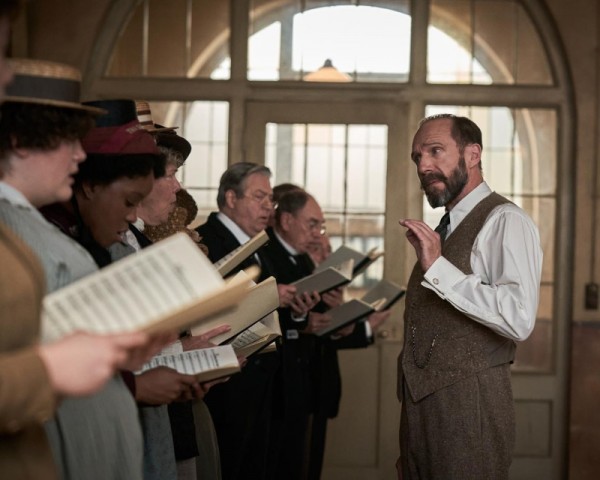
 RALPH FIENNES IN THE CHORALTRAILEREngland 1916: sex and art in a time of war
What have director Nicholas Hytner, 69, and writer Alan Bennett, 91, done in collaboration together before their current venture, the new film
The Choral? Quite a lot, actually. Hytner directed many of Bennett's plays during his tenure as Director of the National Theatre (2003-2015), and thereafter. They have successfully adapted several of Bennett's stage plays into acclaimed films:
The Madness of King George (1994),
The History Boys (2006), and
The Lady in the Van (2015), alongside directing Bennett's TV series
Talking Heads (2020).
The Choral is their first project originating entirely as a screenplay, not a stage adaptation. There's far more to it than some think. Under its traditional look, it's full of fresh material.
The setting is World War I in the fictional Yorkshire town of Ramsden, England, whose male population from 18 to 40, like everywhere else, is being ravaged by this horribly destructive conflict and the eagerness of young men to go off and die in it. Even the choirmaster has decided to enlist. But here, the choir and its annual performance of a major work like the
Saint Matthew Passion is important enough so a new leader is brought in against a big reservation: Dr. Henry Guthrie, a distinguished choir director, has lived and worked in Germany because he found the choirs better there - but he has, of course, had to come home now. Not to worry: Guthrie is played by Ralph Fiennes, and if that doesn't mean a man is alright, what does? Local authorities will train Guthrie not to say German words so much, and he will lead a reconstituted wartime choral group to a triumphant performance. This is like a sports film, only it ends not with the big game but the big concert - and a substantial excerpt of the concert is included. This a musical film.
Nothing earthshaking happens here, but this is Alan Bennett, so the material is frank, emotional, and touches the heart. What appears at first to be a movie that could have come out in the 1950's, has an approach to sexuality and disfigurement that belongs to recent times. This film has the traditional authentic feel, great ensemble work, depth of casting, and precise period flavor of English studio pictures of the last midcentury, but it has the extra emotional heft, frankness, and wry humor that Bennett and Hytner deliver.
Maybe you have to like traditional English pictures, but if you assume this is just that you'd be wrong because there is more of an edge. Notably there's Clyde (Jacob Dubman), a passionate young man back from the war missing his right arm who still has a gorgeous voice, and his return is a godsend for the choir. But he must beg his old girlfriend, who has ditched him, to masterbate him just one more time. There's Duxbury (Roger Allam), the older man who owns the mill and holds the choir's purse strings. He has a lead part in the chorus, but faced with Dr. Guthrie he must recognize that he has a mediocre voice. "I wish I didn't love singin', " he tells his wife. There's Mary (Amara Okereke), a feisty young Black women who usually sings on the street in the Salvation Army. In the chorus with her strong voice and her personal magnetism she is a force and an attraction for several of the liveliest of the young men, who're all color blind.
The choral performance being prepared, the main action of this film, must be a transformation showing how hardship, deprivation, and suffering, so Dr. Guthrie believes, form the raw material of art. He tells Clyde this. The chorus now draws on old men and teenage boys, along with the women, some of them fresh widows both heartbroken and looking eagerly for replacements. Dr. Guthrie and his fellow choir directors go around the town looking for more male singers. One they find is the tall, plump bakery boy Lofty, played by local newcomer Oliver Briscombe, who was never in a film before.
They can't do anything by a German composer, which rules out Bach, Brahms, Mendelsohn, and Mozart and therefore the greatest works of the choral literature, including two requiums and the
Saint Matthew Passion. The solution Dr. Guthrie hits upon is
The Dream of Gerontius, a choral work less than a decade old by Edward Elgar, the great English composer who at that time was still living. He is impersonated with stentorian pomposity by Simon Russell Beale. Elgar's
Dream relates the journey of a pious man's soul from his deathbed to his judgment before God and settling into Purgatory. Elgar disapproved of the use of the term oratorio for the work and when due to his appearance an hour away to receive an honorary degree, he disapproves everything about Dr. Guthrie's "art from art" reimagining and technical scaling-down of his composition.
Watch for the show-stopper speech of the film when a local dignitary declares "purgatory" inappropriate because a Catholic, not Anglican, concept, and Clyde tells all those listening how well you know what purgatory means if you've spent time in the No Man's Land at the front in World War I.
Painstakingly brought to town, Elgar condemns and refuses in any way to sanction this production of his work and goes off in a huff in his chauffeur-driven open-car 1910s silver Rolls Royce, a vehicle that is a choice piece of period theater ih itself. But the show goes on, Alan Bennett and Nicholas Hytner striking a blow for free invention and liberal adaptation in the name of, well, art for art's sake, I suppose. And there have been numerous carefully followed-through couplings and goings-off by train to the war, including a boy who gets a freebie at the local lady of ill fame's place so if he dies, it won't be as a virgin. One remembers the immortal French lesson in
The History Boys when Hector and his boys decide to conduct the entire French class in French and set it in a brothel.
What better than to give Peter Bradshaw of the
Guardian (who gives it four out of five stars) the last word on this charming (but locally undervalued) film? He says of
The Choral that "the humour is delivered with the same conviction and discreetly weighted force as the sadness," and notes that the same goes also for the film's "determinedly unbowdlerized view of sex." Speaking of the young one-armed veteran's suffered indignities Bradshaw says "Perhaps this is Bennett’s late style: a wintry, comic acknowledgment of mortality." In something so ostensibly conventional and bland, Bennett and Hytner have found surprising depths of passion and honesty.
The Choral, 113 mins., premiered at Toronto Sept. 5, 2025, showing also at BFI London, São Paulo, AFI US, Palm Springs. Distributed by Sony, US theatrical opening Dec. 25, 2025 (Jan. 9, 2026 SF Bay Area). The very harsh
Metacritic rating is 59%: something seems really off about that. In sharp contrast Glenn Kenny's in
The New York Times was 90%. The truth is somewhere in between - shall we say 79%?



 FAQ
FAQ Search
 Login
Login
