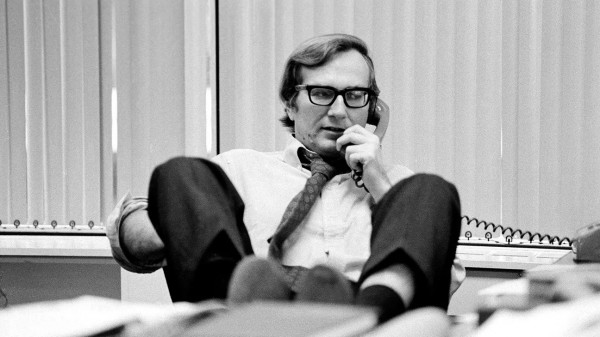
 AN ARCHIVAL IMAGE OF SY HERSH FROM COVER-UP Investigative reporter Seymour Hersh's career reviewed
It ends "Dedicated to all those killed and denied justice, and to those who resist, past and future." Fine. But this documentary is about journalism. It's about perhaps the most important reporter of our time (he may think so) - and that goes back a ways. For Seymour M. ("Sy") Hersh was the key reporter of the My Lai massacre during the US war on Vietnam and about the Abu Ghraib torture in the US Iraq war, and many other topics. He broke the stories. The rest of the world chimed in. You should perhaps also read the
Wikipedia article, "Seymour Hersh," for a straightforward summary of the man's life and main achievements. This documentary is very good indeed (Hersh a great subject "by turns charming, surly and vulnerable," as Sheri Linden's
Hollywood Reporter review puts it) but not quite up to the best of Poitras' other documentaries, which include
Citizenfour, a lengthy interview with whistleblower Edward Snowden after he was forced to flee the US, and the recent
All the Beauty and the Bloodshed, about the life of photo-artist Nan Goldin and the culpability of the Sackler family in the opioid epidemic. Those were front-line reporting; this is a review of the life of an older generation front-line reporter. Nonetheless, this is essential viewing for news buffs.
The background is easy. Hersh, son of Lithuanian Jewish immigrants in Chicago, was a natural writer who was brash and sociable. The ingredients that have made him so significant are complex, though. Dedication is a big part of it, balls, persistence, rejection of the bland party line conventional journalists fall into, the crowds of Pentagon or White House reporters who sit and copy what they're told. Hersh eschewed that and went and interviewed Pentagon brass privately. His method, that of any reporter who is set apart, is cultivation of sources. Hersh is especially known for his use of anonymous sources. It is when duo Laura and Mark start to delve into those and he thinks he has revealed too much about them that at one point Hersh calls a halt and says he wants to stop dead this film Poitras had been trying to get made for twenty years.
He is not an easy subject. "I have been very happy not talking about myself," he says at that difficult key juncture when he calls a halt to the whole entreprise of this film. It is by cultivating anonymous sources and zealously protecting them that he has been able to get the information he has gotten and done the reportage that he has done. He has been dealing with top military brass, with officials of the CIA and the FBI, people who were not going to reveal themselves because they were too visible, or small figures who would be crushed.
Repeatedly, as the film title signals, those various and unknown sources' willingness to speak to Hersh privately has come from discomfort with things that have been covered up, as the government wants to do with anything that might be at all embarrassing, humiliating, or ugly. A young military officer carrying out the murder of three hundred innocent civilians. Rank and file of Army and CIA wantonly torturing and killing innocent people.
But there is also Watergate. The dirty tricks of a major political party to ensure its power. The naughty, embarrassing scheming of Richard Nixon and his White House cronies, including a major Hersh target, Henry Kissinger. Sometimes as a personality Seymour Hersh feels like an outsider. He may have had many who disliked him, for example for his exposure of Lieutenant Calley and My Lai. Many thought Calley was a hero, the unjust scapegoat. Responsible for hundreds of innocent dead, Calley wound up doing only a few months of jail time, because so many favored him. A song celebrating him, we see, was a record widely hawked and played on the radio. People have a limited appreciation of the First Amendment's importance. This is perhaps an even worse problem today. Or, as Hersh says, "People condemn the messenger."
But Seymour Hersh is not an outsider. He's just a hot item. He remains this now, well into his eighties. And we see him being contacted with someone with information to expose (not now, but it will go through him when the source is ready to reveal it) about the systematic nature of Israel's conduct in its war on Gaza. Hersh has been at work for sixty years. (He also has had a long and sustaining marriage, which he briefly talks about.) Not an outsider--but more an outsider recently. He was at one time a broke freelance, when he came upon My Lai, but that led to being a respected reporter of the
New York Times. That was, we learn, till he began reporting on corporate wrongdoing--and the
Times was and is a corporate-run enterprise.
Hersh has also written eleven books (discovering his freest and fullest medium of reportage), and (for his best-edited work?) has frequently published essays in
The New Yorker. We glimpse many of these. Only, when his reportage on Syria deepened, he was pushed to the
London Review of Books, then sometimes exclusively online, to Substack.
This film, like many documentaries today, gives the viewer scans of the top ends of newspaper clippings; not to mention glimpses of Hersh’s own archive of photographs, notebooks, maps, and highly confidential documents, but often without pausing long enough - unless this is viewed online with a pause button and a magnifying glass at hand - for you to read anything. There needs to be better way than this game of doc film peekaboo.
Hersh is an unforgettable and persistent personality, not necessarily a likable one. That voice he has, that way of speaking, (familiar to me from "Democracy Now!") at least partly captured here, as he becomes the narrator of this film once it gains its final momentum--revals a sui generis, not unattractive manner of knowingly nattering away, coming back and grabbing a phrase again, never quite completing a thought, but never letting go of it either. The voice seems tentative, but cuts like a knife. Contrast the voice of his opposite number at the
Washington Post, Bob Woodward, who with Carl Bernstein famously exposed the Watergate scandal, when heard from here, with its different register, deeper, calmer, almost soothing tone. Hersh provokes, stimulates. Any conversation with Hersh would be not all about him, but also that, through being all about whatever he is focused on at the time. You may admire more than like him. But he is essential, and this film has captured a lot of him and his essential work. And as "essential" means, our history might have been different without him.
There is a mix of cockiness and despair here that may have typified Hersh's career and life. Note LIeutenant Calley's light sentence; how much the depredations of past US administrations are forgotten now; how simply awful were the wrongdoings he exposed, the violence he thinks leads to the excusing, the willingness to cover up. The subject matter makes this one of the most important docs of the year.
Cover-Up, 117 mins., premiered at Venice Aug. 29, 2025, showing also at Telluride, Toronto, New York, Bend, Athens, Vancouver, The Hamptons, BFI London, Woodstock, AFI, Vienna, Stockholm, DOC NYC, and many other festivals. Limited US theatrical release Dec. 19, 2025. Now on Netflix.
Metacritic rating: ̶ ̶8̶5̶%̶



 FAQ
FAQ Search
 Login
Login
