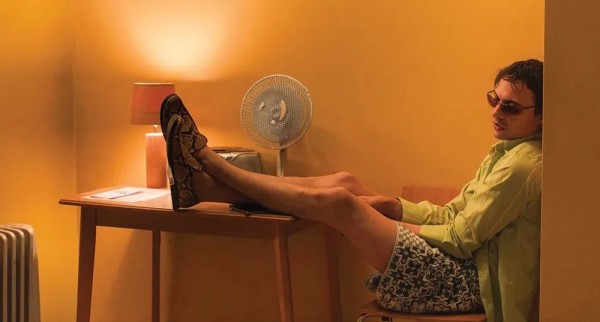
 FRANK DILLANE IN HARRIS DICKINSON'S URCHINTRAILER HARRIS DICKINSON INTERVIEW Young man caught in a whirlwind
 Let's start with Katie Walsh of
Chicago Tribune: "Dickinson, who became a heartthrob in movies like
Beach Rats, Triangle of Sadness and
Babygirl, announces [with this directing and writing debut] that he’s much more than a pretty face, he’s got something to say, and the message of humanist compassion he delivers in
Urchin is incredibly powerful." I'd not have said it quite that way, but Dickinson has used something of his attractiveness and young maleness in his films as an actor in one way or another most of the time, certainly without projecting social responsibility. What he has shown is an unusually wise and sly range of interesting choices that made one eager to see what he would do as a writer and director. And he has done this little movie, which is stunning.
What makes it so is a mixture of good writing, packed with unexpected, specific detail, selfless, utterly convincing acting by lead actor Frank Dillane, and the surprising insight into interior life conveyed by beautiful surreal passages such as one does not expect in a "social realist" film à la Mike Leigh.
Perhaps the homage to Leigh is the lead's name, which is Mike. Mike is young, tall, well built, but there's a blankness about his stare and he does not comb his hair, nor is it a good look. What primarily strikes one perhaps after a while is that he has no framework. He's adopted, another time he admits he dropped out of school "quite early." Yet another time he admits he lived homeless for five years. Why would an able-bodied young man, good-looking when fixed up, do a thing like that? The answer doesn't come right away and perhaps he doesn't know it himself. It only comes in the end of an arc when he has picked himself up pretty well and then progressively sinks down - back into homelessness, addiction and alcoholism, a have-not who's the brunt of the haves and of his own vulnerability . Dickinson conveys these stages as tipped off by surreal visions. Early on a bum playing Bach on the violin stops and stares and turns into a sort of shaman. Later there are swirling images to float in.
Dickinson appears himself early on in cameo as a "friend" called Nathan who steals Mike's wallet which he violently steals back. In retribution Mike commits a cruel and unsympathetic act when a decent man offers to help him and he assaults him and steals his watch to pawn at a shop for 40 quid. But the CCTV cameras have caught it all and he's soon arrested and sent to jail for what turns out to be eight months.
And it's not the first time, though the lenient UK system gets him out in under a year and provided with a hostel room and a job in a hotel kitchen as a cook. He's got an external framework now - a room with a fan and a light and a tape player upon which he listens to motivational, meditation tapes that carry him away. He's given meetings with a supervisor, Nadia (Buckso Dhillon), a counselor, Scott (Michael Colgan). The latter arranges Mike an interview with Simon (Okezie Morro), the man he assaulted. But he has nothing to say, no apology prepared. Not a good sign.
Bradshaw of the
Guardian suggests[ it's because Mike can't deal with this that it starts his downward spiral. Still things seem for a while to be getting better with Mike enjoying his meditation tapes, even bringing Nadia a little present, also confiding in her his plan to start and supervise a luxury chauffeur business.
Under duress he's quite well spoken and presents a good front. Hence the companionship of two women colleagues at the restaurant who take him to karaoke. But all this will end because of resentment, fear of failure, anger, the downward pull. He's no cook and dishes come from his hand overcooked or undercooked and there are complaints of diners that he takes ill. He gets into fights at work. He's fired.
The last phase almost comically - and the whole story is never too far from humor, far from miserabilism and closer to wonderment - Mike calls up and asks for an old gig back in a crew emptying rubbish bins. It's here that for the first time in years he connects with a woman (Megan Northam), who's French, and lives in a kind of shack on public land. They talk and then briefly make love. She introduces him to a couple, the man, full of blather about being working class, possessed of Ketamine, a drug, I see, that is "abused for its ability to produce dissociative sensations and hallucinations." For Mike it is linked also to wave on wave of alcohol. Here the film resorts briefly to montage to show Mike's wild energy when high and partying among different people. Aroused and numbed, he steals money and pours it into drink.
Twelve-steppers speak of a "bottom" but for Mike there are many bottoms. The film chooses to stop in midair. Certainly it's not a good place but for the moment he's floating, himself swirled round in that surreal void we encountered much earlier in this short but richly eventful film. It's a quietly dazzling moment helped fly by the unusual choice to accompany a young man going under in an alcoholic and drug stupor: a Caprice in A minor by Paganini. Mike is viewed cooly, no weeping, no finger wagging. He's just held up for us to look at. A memorable directing and writing debut by Dickinson with much promise for the future for both him in this role and Frank Dillane as an actor.
Harris Dickinson's work as an actor includes
Beach Rats, Triangle of Sadness, County Lines, Scrapper, The Iron Claw, Babygirl, and the series "A Murder at the End of the World."
Urchin, 100 mins., premiered May 17, 2025 in Un Certain Regard at Cannes. Included in nearly three dozen other international festivals including Munich, Karlovy Vary, Jerusalem, Melbourne, Telluride, Bangkok, Leiden, Warsaw, Vienna, Taipei, and many others and opening theatrically in the US with limited release in New York and Los Angeles Oct. 10, 2025, expanding nationwide Oct. 17, 2025, with distributor 1-2 Special. Now (Dec. 2025) available on all major platforms online.
Metacritic rating: 77%.



 FAQ
FAQ Search
 Login
Login
