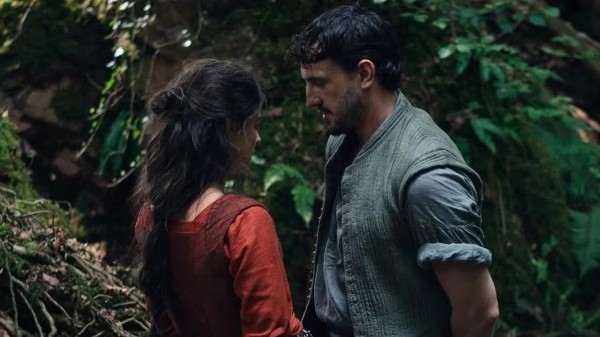
 JESSIE BUCKLEY AND PAUL MESCAL IN HAMNETTRAILERCaviar to the general
This film is adapted in collaboration with its author Maggie Farrell from a book that imagines details about William Shakespeare and his family, especially about the bard's son Hamnet, fraternal twin of Judith, who died at eleven. This story tells us the boy died of plague, in terrible pain, to the great anguish of both parents. It goes further to suggest the play
Hamlet was written by Shakespeare to expiate guilt he felt for not being present in Stratford-upon-Avon but in London when the boy died, and as a working out of his guilt and bidding adieu. While some critics find this film beautiful and moving, others like myself see it as artificial and manipulative.
Chloé Zhao is a worthy and talented filmmaker. Her trajectory has been confusing. Directors have every right to experiment and change from film to film, of course. But for me while Zhao's debut
Songs My Brothers Taught me was touching docufiction, her focus on the Pine Ridge Reservation and her docufiction approach peaked with her second, more focused film
The Rider, which concentrates on a young cowboy wrangler struggling with a brain injury that put him out of commission and robbed him of his identity and manhood. With her third film
Nomadland however it was that Zhao hit pay dirt, so to speak, by focusing on America's economic drifters and using the gifted Frances McDormand: six Oscar noms and three wins, including Best Picture. Zhao went astray after that making a sort of superhero Disney film,
Eternals (Metascore: 52). A pause, then apparently meeting the terrific Irish actor Paul Mescal, Zhao was inspired to make
Hamnet, and go for more Oscars, because the new film seems high on the awards list this year.
For me it is her worst film. But we know the Academy likes tearjerkers and actors who, let us say, act very emphatically, which Paul Mescal and fellow Irish thespian Jessie Buckley get plenty of opportunities to do. See the film and decide for yourself if it sounds appealing to you. Shakespeare weeps. But does he also turn over in his grave? Though various critics mention weeping at their
Hamnet screening, for me that didn't happen.
One big reason for this: the overemphatic acting of grief. In his
review of
Hamnet, Mike D'Angelo notes in
Jay Kelly, the titular character says "the best way for an actor to make the audience cry is to
not cry", and
Hamnet's leads, in contrast, cry so much it's a turnoff, an alienation effect. (Though, as D'Angelo also notes, it may be moving to others to see terrible grief emphatically expressed.)
The source novel, by reports, is magical and rich in language, particularly in introducing and creating, the fairy-like, wise, woods-dwelling woman who is to be Shakespeare's bride. But the
BBC review by Nicholas Barber says "Zhao and O'Farrell have stripped away so much of what makes the novel magical – the time-travelling structure, the hypnotic prose rhythms, the internal monologues and the tiny, tangible details – that what's left is no more profound or authentic than any other costume drama set in ye olde days."
But it doesn't seem so much "in ye olde days" to me either. Rather it seems a film in the spirit of Terrence Malick (though without the hushed voiceover musings): the mystical natural light (plus maybe too much semi-darkness), the droning score, the earthy characters in loose garments in the dawn of their feelings. One reason this doesn't work is it doesn't capture the grounding Elizabethan setting beyond the clothes and the Tudor architecture of the hovering town of Stratford-upon-Avon. The story isn't about Shakespeare himself, we get that: it's about his wife. But then, there isn't ultimately much about her in the film. In the end, it's just about their grief. And a fictitious connection between a single famous play and a personal loss.
The film is a gripping fairy tale that ends in such a compelling wallow in sadness that it has been called "grief porn" by at least two writers, first Nick Schrager in
The Daily Beast in September and more recently in the title of Justin Chang's review of the film in the Dec. 1
New Yorker. There's something worse than that, mentioned in Chang's review: this story plays to the erroneous assumption that there has to be an autobiographical element in a great work of art or literature, and that it was done as therapy.
D'angelo puts this bluntly as a disappointment, that "Finally,
Hamnet does what I assumed and feared it would: posit Hamnet’s death as the primary creative impetus for
Hamlet. That’s always struck me not just as bullshit but as downright insulting bullshit, treating arguably the English language’s greatest writer as if he were doing an exercise assigned by his therapist." More generally, D'Angelo concludes that "The whole impulse behind
Hamnet (novel or film), striving to locate or theorize some autobiographical tidbit lurking beneath every creative act, strikes me as fundamentally anti-art." Justin Chang, the
New Yorker film critic, expresses all this with more restraint (along with some nice things about the film D'Angelo, unmoved, like me, omits). He says the story plays to the erroneous assumption that there has to be an autobiographical element in a great work of art or literature, and that it was done as therapy. (Chang does mention doing some weeping, though.)
The film begins by reimagining how Shakespeare (Mescal) and his wife Agnes (Buckley) fell in love, first meeting when the playwright was working as a Latin tutor in the same village she lived in - but she spends a lot of time in the woods. She is viewed by some in the village as a witch. Their early courtship is awkward, woodsy, Malickian. They marry, there's a long childbirth scene. The second twin is the girl, Judith, who seems challenged, and special.
Then all of a sudden a decade has passed, and the twins, Hamnet and Judith, are great pals. Shakespeare - though his name is only mentioned at the end - has to go to London and work in the theater, and Hamnet misses him, but his father teaches him the elements of theatrical swordplay - for later, because Hamnet can't come to London with him yet. The boy's dream is to act on the stage, his father's stage. (But there is nothing about the career of the greatest playwright in English, perhaps in any language.).
We won't speak of the ending, which involves a visit by Agnes with another family member to her husband's theater for a performance of
Hamlet. The main role is played by a teenage boy (as was often true at the time), and the actor is Noah Jupe, the older brother of Jacobi Jupe, who plays Hamnet. The ghost (of Hamlet's father) is played by Shakespeare himself. This leads to some ingenious twists and turns of relationship - more ingenious than the more wince-inducing use of set phrases from Shakespeare into dialogue of the film, worst of all the recitation of "To be or not to be" by SHakespeare in his own person by the Thames during a moment of self-doubt. The play's the thing, and this theatrical segment seemed to me the most interesting part of the film. It asks us to think.
It doesn't matter why a work of art was done, even if it was done to make money, or stay working, or was also partly a play for 2026 awards as
Hamnet is seeming to be. Or maybe it does sometimes, because as Zhao has gone from her first to her fourth feature the popularity and awards appeal has gone up but the authenticity hasn't kept pace.
Hamnet, 125 mins., premiered at Telluride Aug. 29, 2025, showing also at many other international festivals, including Toronto, Woodstock, Mill Valley, BFI London, etc. Limited US theatrical release Nov. 26, 2025.
Metacritic rating: ̶8̶2̶%̶. Now 83%.



 FAQ
FAQ Search
 Login
Login
