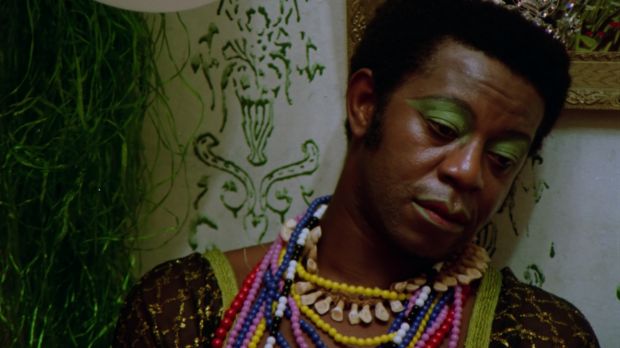
 MILTON GONÇALVES IN THE DEVIL QUEENTRAILERColorful Brazilian camp newly availableA Rainha Diaba
 aka
The Devil Queen is a 1974 camp classic from Brazil that has been transferred to a 4K digital file, soon to be widely released in the US by Kino Lorber, starting in New York and Los Angeles.
The film is a florid gay fantasy that has a basis in fact, of a force in Rio de Janeiro’s criminal underworld represented by a powerful ambisexual drag queen played by Milton Gonçalves. This is a variation on the story of "Madame Satã" (a title borrowed later from Cecil B. DeMille) depicted in
Karim Aïnouz's debut film of that title . Both films are based on the historical figure João Francisco dos Santos. I reviewed Aïnouz's debut almost a quarter century ago. It's a loose biopic of the notorious transvestite, cabaret performer, street fighter and prostitute who pushed the boundaries of behavior in 1930s Brazil.
In Aïnouz's film João is wonderfully played by a wiry, fiery Lázaro Ramos, who gives his all yet never seems to be pushing. Music is restricted to diegetic and the prevailing constant sound is the noise of people in the street, like the echoes of voices in a prison. (See Roger Ebert's original
review).
In Antonio Carlos da Fontoura's three decades earlier film
The Devil Queen, Diaba (Gonçalves), the "Madame Satan" character based on DeMille, is a femme queen with a taste for power and violence and ambitions of being a gang boss. Action of the film is set off by the police coming for Diaba's boy toy and her subsequent machinations to offset this development.
Madame Satã is an intimate, impressionistic period thirties character study. It focuses on the turbulent years leading up to João Francisco’s stage debut, showing him as a complex, vulnerable, and fiercely proud individual who builds a chosen family of outcasts. The handheld camera work, sometimes hyper-focused, sometimes blurry, is visceral and grounded, featuring close-ups and an everyday focus on his internal struggles. João 's anger is mysterious and troubling, but the overall mood is curiously positivie.
Fontoura's
The Devil Queen (1974) leans heavily into stylized genre cinema, resembling a colorful, campy gangster thriller set in the present day. It centers on a fictionalized crime boss known as "Diaba," utilizing highly saturated, psychedelic aesthetics. The tone is audacious, aggressive, and theatrical. Fontoura is going for dark, violent crime epic - quite the opposite thing.
The Devil Queen spends time on petty machinations. Lots of quirky nicknames, shootings, fake blood, forced laughter, sadism. At one hour the monotony is relieved by a colorful party, gratuitous, but entertaining. Diaba becomes interested in Bereco (Stepan Nercessian), the "pretty one" among the petty thugs, who, like the others, would betray him. The two films make for a very odd Brazilian double feature - perhaps a prelude to virtuoso treatments of poverty and youth like Hector Babenco's
Pixote of Fernando Meirelles and Kátia Lund's
City of God. But though uneven in tone,
The Devil Queen winds up being a somewhat comical horror movie that's very moral: bad guys don't do well.
Beyond that, its visuals are striking. Mateus Nagime wrote in
Senses of Cinema that A Rainha Diaba "has influenced many other Brazilian films on crime and LGBTQ characters," and it's been said to have provided a partial tempate for Pedro Almodóvar's early work.
The Devil Queen/A Rainha Diaba, 100 mins., premiered May 27, 1974 in Rio de Janeiro, showing in many festivals and despite its crudity received many awards. The restoration (which premiered in 2023, now in wide release by Kino Lorber) has a Jun. 5–11, 2026 pre-release engagement at Gene Siskel Film Center, Chicago, a Jun. 12 theatrical premiere opening at Film Forum, New York, and a theatrical release at Alamo DTLA in LA Jun. 17. It will release limited nationwide from Jun. 19.
Opens June 19th at Lumiere Cinema, Los Angeles.
Kino Lorber is reissuing the film on Blu-ray d under the Kino Cult line (Release #53) and comes from a new 4K restoration. Release Date: August 25, 2026. Price: Currently (early June 2026) available to pre-order for $19.92 (discounted from $29.95).



 FAQ
FAQ Search
 Login
Login
