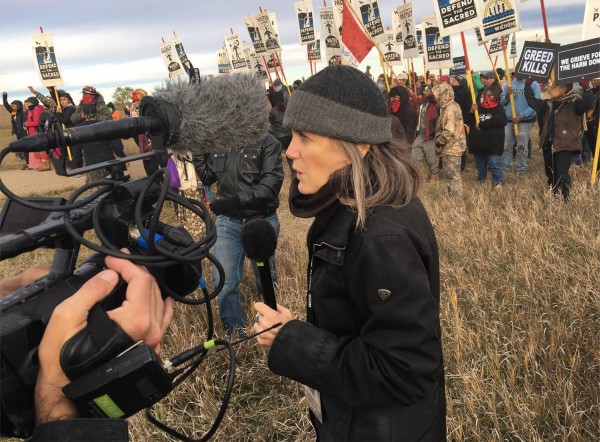
 AMY GOODMAN AT THE STANDING ROCK OIL PIPELINE PROTEST, OCT. 2016 | Courtesy of Reed Brody Overdue portrait of an essential journalist and her independent news program, "Democracy Now!"
 In her own way Amy Goodman may be as important an American journalist of the last forty years as Seymour Hersh, who got his own film recently in Mark Obenhaus and Laura Poitras's excellent documentary,
Cover-Up (q.v.). As followers and fans of her radio and TV news show "Democracy Now!" are well aware, Amy Goodman is an independent radio and TV journalist who, with her small crew, often covers stories other American journalists do not. For those who (the reasons should be obvious) feels the need to follow the news without reliance on mainstream journalism, Amy Goodman seems like, to this writer, an essential source. And yet, her audience is relatively small. This film does not go into those larger issues. It is primarily a portrait of Amy Goodman's 40-year career, even going back to when she first compiled a family newsletter as a kid. As a bio, it is admirable. Speaking as one who personally followed her program (on radio and later online) on a daily basis for years, however, the film feels vaguely lacking as a portrait of Amy's coverage of the great news stories of our day. But there is just so much to cover.
The film begins with something new and a picture of her doggedness, not necessarily of her effectiveness, as a reporter who covers power. It follows her closely following Trump's representative at the 2018 United Nations Climate Summit in Katowice, Poland. She has covered these climate summits for years. She is following P. Wells Griffith III, who was the international energy and climate advisor to President Donald Trump at the time. She is asking him to explain why Trump pulled the U.S. out of the Paris Climate Accord. He declines to answer, saying he is "running late." "But you weren't running late when you were just standing there," Goodman comments.
This is news coverage as theater. It is of value not because she got an answer, but because it shows the stonewalling. And so it is best designed for TV. As in-print coverage, it would be reduced to "When Trump climate advisor P. Wells Griffith was asked why the Trump administration withdrew from the Paris Climate Accord, he declined to answer."
Key stories covered by Amy Goodman that are described in this film include the 1991 East Timor massacre, collusion between oil companies and the Nigerian military, post-9/11 health issues, the 2008 Republican National Convention, and recent anti-war protests. Amy Goodman, along with journalist Allan Nairn, covered and personally witnessed the Santa Cruz massacre (also known as the Dili massacre) in East Timor on November 12, 1991. This therefore has remained one of the stories closest to her heart and most completely neglected by other journalists. The widespread illness and deaths following the inadequately dealt-with post-9/11 air-pollution situation is personally significant because the firehouse where the "Democracy Now!" studio was at the time was itself very close to the destroyed Twin Towers. We see Amy coughing, and we wonder.
With Americans' infinite capacity for forgetting history, this story that rocked the nation and the world only 25 years ago seems rarely thought of today. September 11, 2001 may have been when I personally first heard of Amy Goodman, when someone told me that in reporting on the event that morning "Amy Goodman was crying." "Who's Amy Goodman?" I wondered. The toxic aftermath of the destruction of the two buildings was not only underprotected but underreported, but not by "Democracy Now!".
This film describes Amy's activism with the feminist
Seven Sisters publication at Harvard. After college she tried repeatedly to get a job on Phil Donahue's talk show, which she admired for covering relevant issues. When she was roundly rejected, she gave up on TV and joined Pacifica Radio's New York station WBAI, where in 1996 she founded the hour news program, "Democracy Now!" and also helped lead a campaign to release death-row prisoner Moreese Bickham from Angola State Penitentiary in that year. The history of her career outlined by this film runs all the way to her coverage of the massive, landmark Jewish Voice for Peace protest at Grand Central Station in November 2023. A highlight of the story of Amy's consistent "thorn-in-the-side" performances as a newsperson is her radio interview with Bill Clinton on election day in 2000, when a five-minute call-in turned into a thirty-minute grilling where she kept questioning and he kept answering.
This film doesn't delve deeply into Amy Goodman's private life (if she even has time for one). It does show her visiting graves in Ukraine of her Jewish forebears. It explains that while having a grandparent who was a rabbi, she grew up in a secular Jewish household on Long Island where her parents were involved in social action, working for peace, and integration, while her father, George Goodman, was an ophthalmologist and her mother, Dorothy, was a teacher and later a social worker.
The film highlights some of the people who have shared the spotlight with Amy at "Democracy Now!": Juan González, co-host and prominent investigative journalist, a rakish activist and leader in his youth with the militant Puerto Rican civil rights organization the Young Lords; Nermeen Shaikh, the British-educated co-host and senior producer; and Egyptian-born, Duke University graduate Sharif Abdel Kouddous, a field reporter and producer for the show. Abdel Kouddous was interviewed for the film, but it goes unmentioned that he returned to Cairo and stood in Tahrir Square where the January 25 (2011) revolution began that swept the Arab world. His coverage of the events for a US publication as an Arabic-speaking Egyptian-born reporter seems unique, but this is not stressed here. (Subsequently he has remained in the Middle East largely working for the Intercept, not mentioned here.)
The emphasis is on Amy, but those around her do not go unmentioned: even her dog, Zazu, is shown proudly being walked by Amy on New York sidewalks. Zazu is reportedly a Zuchon, a designer mix between a Bichon Frise and a Shih, though those details are not given in the film. Amy's personal life, such as her relationship status or significant other, is kept dark, doubtless at her wishes. Nor are outside criticisms or imagined shortcomings of Amy or her reportage considered - except for the question of whether reportage and activism can be combined, as she sometimes seems to do. Though there may be no decisive answer, it seems clear that "Democracy Now!", regardless of its left leanings, is all about fair and honest reportage.
While the title may read as an allusion to Abbie Hoffman's memoir
Steal This Book, it specifically refers here to Amy Goodman's advocacy that, rather than follow the proprietary logic of corporate news distribution, independent media should freely share their coverage with other outlets. A positive example is the way Amy Goodman’s coverage of the 2016 Standing Rock Dakota Access Pipeline protests showing private security attacking protesters with dogs and pepper spray went viral and was picked up by major mainstream outlets like CNN, MSNBC, and CBS. Too often though, as with the human toll of the war in Afghanistan, climate chaos and the climate summits, and immigrant struggles, "Democracy Now!" has been largely a lone voice.
Hopefully this film will acquaint that needed larger audience with "Democracy Now!" and Amy Goodman's singular achievements, and increase awareness of the dismal failures of mainstream media in the US to cover what is going on in the world independently. We need more programs to hold the corporate voices to account. Let there be many "Democracy Now!"s!
An evening to
celebrate 30 years of "Democracy Now!" was held March 23, 2026 and this can be watched online - as can "Democracy Now!" past programs where historic figures like Angela Davis, Noam Chomsky, Harry Belafonte, Leonard Peltier, and labor icon Dolores Huerta have been interviewed and given a voice not available to them elsewhere.
Directors Tia Lessin and Carl Deal produced several Michael Moore films and as filmmakers made the Oscar-nominated 2008 Hurricane Katrina documentary
Trouble the Water and the 2022
The Janes.
Coverage of this film can be found by Pat Mullen in
POV Magazine and Lee Marshall in
Screen Daily.Steal This Story, Please!, 101 mins., premiered Jun. 12, 2025 at DC/DOX (Spain), debuting in the US at Telluride (Aug. 31, 2025), also showing at Mill Valley and Woodstock. It showed at IDFA Amsterdam and DOC-NYC. Nov. 2025. This film premieres in NYC Apr. 10, 2016 and in SF/LA Apr. 17, with staggered release across the US following.
Metacritic rating: 71%.



 FAQ
FAQ Search
 Login
Login
