 CLAIRE SIMON: WRITING LIFE: ANNIE ERNAUX THROUGH THE EYES OF HIGH SCHOOL STUDENTS (2025) - RENDEZ-VOUS WITH FRENCH CINEMA 2025 Literature as female empowerment
 From her descriptions Claire Simon appears to have arranged to have the works of the French writer Annie Ernaux, winner of the 2022 Nobel Prize for Literature, read by students and then filmed their discussions of them conducted by teachers, mostly in classes, a few in informal settings such as a bus stop. Ernaux has written over two dozen books, mostly autobiographical in nature and frank in subject matter in a style she calls " l’ecriture plate," "flat writing." Her intentionally unadorned descriptions include the discovery of a lost sister, a sexual assault, a miscarriage, and an illegal abortion. (The latter has been made into an award-winning film, Audrey Diwan's
Happening/L'Événement (2021) Passages from these are read by girls, also by a few boys. The discussions necessarily take on a feminist perspective.
The classes are in various parts of France as well as Cayenne, in French Guiana, and many of the students are non-white. A few are in the Paris region. It appears to be warm, sunny weather. The locations are given for each section but other explanations are left out. There is no external commentary.
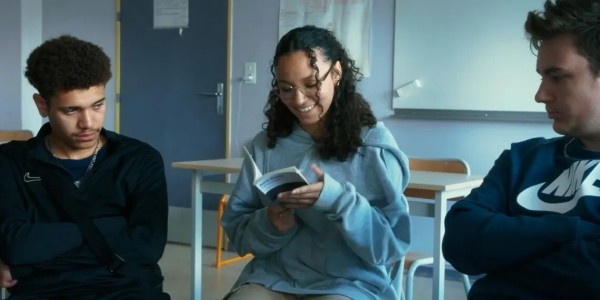
The outspoken frankness of these passages comes through, particularly the miscarriage. The girl laughs as she begins reading it (see photo above), perhaps from embarrassment. Opinions vary, but generally the students overwhelmingly approve the writing - though the BFI reviewer,
Laura Venning, wonders "if more disparaging comments were left on the cutting room floor." They find it easier to relate to than the usual "Bac" fare of classics like Balzac or Flaubert, Molière or Racine. On the other hand, if students in French lycées spent all their time on Ernaux or other easily relatable writers they would be shortchanged on their cultural heritage as well as their "Bac" exam preparation.
Or would they? As the demographics change, the ability to connect with that cultural heritage may vary also. But the wise literary student may hue to the traditional because it is what we have, whether she agrees with it or not. This is a conflict cogently discussed by E.D.Hirsch, author of the Cultural Literacy books and advocate of the notion of a core curriculum. If we focus only on the current and the relevant, we lose contact not just with the cultural legacy, Hirsch has shown, but with our store of necessary basic knowledge. Annie Ernaux can only be valuable as a side course when the spotlight is on the classics. But this is not the purpose of the film to consider.
Ernaux's Nobel Prize for Literature comes at a time when women are now receiving the award every few years - 2015, 2018, 2020, 2022, while early in the last century they came much more rarely. The Nobel may help qualify Ernaux as an instant "classic," but this is another topic beyond the scope of the film. It is an interesting dip into cultural history however to read the list of names and the different reasons given over the years for the committee's granting of the prestigious award. Notoriously Stockholm has overlooked some of the world's, and particularly the West's, greatest writers, such as Proust, Joyce, Frost, Orwell, Forster (it was "too late" when they were considered). Ibsen and Twain were deemed "too realistic": what would
that committee say about Ernaux? Nabokov was passed up over and over for much more minor and forgettable writers, several of them Swedish and members of the committee itself. Some of the most honored writers in English have been recognized, recently Bob Dylan and Toni Morrison, earlier Faulkner, Hemingway, Naipaul, Pinter, Beckett, Bellow. Despite the scandals, the prestige is there, mattering more for the world now in science.
Ernaux's Nobel recognition reflects these times, and not just the committee's whims. But it feels as if the committee is pussyfooting around when it said it was recognizing Ernaux for "for the courage and clinical acuity with which she uncovers the roots, estrangements and collective restraints of personal memory." That's not "écriture plate," which would come right out and say what she stands out for is how directly she talks about horrible experiences women have gone through due to the cruelty of men. At least the words about Isaac Bashevis Singer when he got the Nobel mentioned the word "Jewish." But calling a spade a spade is not the Nobel committee's way.
It could be Ernaux was writing her "flat" auto-fiction particularly for high school students, as well as for any woman suffering because of her sex. That makes this film particularly relevant. On the other hand a staged series of discussions doesn't
wholly provide the kind of "fly on the wall" picture we seek in a documentary, and fiction films about high school life can be a better picture of it, more fully observed. When there is a young woman or a young man who is particularly bright or articulate here in these scenes recorded by Simon, we wish she had tweaked more to increase their number and, also, to increase the drama.
And what about "writing life" (Écrire la vie)? The students don't read anything they themselves have written. They only read aloud from Ernaux's various texts and comment on them. Nor do they visibly delve into or discuss Ernaux's own personal life as a writer, the risks she took to write the way she did. Simon has done a good job of showing Ernaux's relevance to young people. Now we would still like to know more about Ernaux herself, though her age (she was born September 1, 1940) makes that difficult now.
Writing Life: Annie Ernaux Through the Eyes of High School Students / Écrire la vie - Annie Ernaux racontée par des lycéennes et des lycéens, 90 mins., comes Apr. 8, 2026 to French theaters. Screened for this review as part of the Rendez-Vous with French Cinema at Lincoln Center (Mar. 5-15, 2026). Showtime:
Tuesday, March 10 at 6:00pm – Q&A with Claire Simon



 FAQ
FAQ Search
 Login
Login
