 Oath of poverty of an author doing Uber-style work
THe French review Les Inrockuptibles of Valerie Donzelli's quietly powerful and succinct new film, describes the hero, Paul (Bastien Bouillon) thus: "a rebellious, unconventional artist who chooses fulfillment in poverty and marginality rather than compromise in the limelight." Some French reviewers see the subject of At Work negatively, as a tale of of "uberisation." Surely is not so. Uber is just a thing people do on the way to something else. But Uber reflects a fracturing of work that was simpler before. In the words of the author of the source novel, which is a realistic, experienced-based account, it is "a clever blend of liberty and deprivation." To put it another way, Paul, an established, published writer but not a hugely successful one, allows himself to be exploited for the little things to avoid the big exploitation of a profitable but shameful and dishonest job, like, say, finance or advertising, or even teaching, which is too close to the intellectual activity of writing. Menial work puts the writer in direct touch with life at its most ordinary and keeps him honest.
Paul (Bastien Bouillon, who is brilliant here, and makes the film), is in his early forties, recently divorced with several grown children, whom circumstances lead to be living by himself now; the wife takes the kids to live in Canada. He was a successful photographer, making two or three thousand euros a month. He looks at his cameras, relics now. He will not go back to photography to make money. He has published three novels and is embarking on his fourth.
Though unnoted, the publisher is NRF/Gallimard, publisher of such luminaries as Proust, Sartre, St. Exupéry, Céline and De Beauvoir. Paul is not one of those. His number three did poorly as his editor (Viginie Ledoyen) reminds him. He is making 250 euros a month where before, as a photographer, he made two or three thousand. But Paul wants to write, so he must do other work to live. But not photography, which was another life.
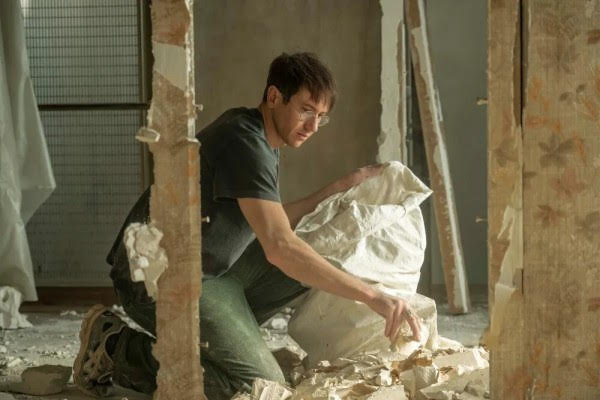
The film is about the work he chooses to do, and about his dedication to the métier of writer. Occasionally we see his editor, and moderately but also essentially we glimpse his wife, played by Donzelli herself. He chooses to work at menial jobs to leave himself time and mind to write and the film focuses much on these jobs. Why not write a bestseller?, his disapproving father (André Marcon) asks. He would not consider it. The jobs are ordinary but sometimes grueling, piecework, miscellaneous gig economy jobs. He takes three hours to cut a lawn because the owner has only clippers. He struggles unloading a metal curved staircase down a stairway out of an apartment for too heavy ahd too cumbersome for one person. He spends ages laboriously removing big boxwood plants (we may pity the plants themselves too) from large planters on a Paris balcony, only to learn that there is another side to the balcony with another eight boxwoods to drag out and bag.
He takes a gold ring to sell, and finds out it's not 18 carat gold. He lets it go anyway, for thirty euros.
Paul is so swamped, and so poor now, he can't afford trips for festive events involving his children who are out of town, and must attend them via Zoom. His hair has been cropped close with clippers: he's like a monk. A friend he dines with says "tu décelaire," you're slowing down, but it sounded to me like "tu désalaire" - you're giving up salary. It's both. Slowly, quietly, invisibly, Paul makes his life workable, earning enough to live on minimally by odd jobs, while continuing to write, and keeping not of all the people and scenes he observes on his jobs.
He is an Uber to and from the airport. One is a lonely lady he goes to bed with on arrival. But they are both out of practice and it's awkward and dodgy. He must give up the loaned space he's moved to and is faced with homelessness, becoming a 'clochard.' His computer gives out and something goes so wrong not only can it not be repaired, but he loses his drive and all his work on it. A lady barkeep has pity on him and leads him to a rest space behind the bar and says he can stay there and write there. He takes to felt pen and pad.
The whole business, the family, the publisher, the odd jobs he does for a pittance to get them from the hot online competition, life day to day, go into the packet of pages he produces and gives to his editor. She directs it to be typed up and bound and when we see that, we know good news has come at last. She finds the book good, it will be his next book.
At the signing, he gets a text about a job, a referral from a previous client. "In two hours?" he texts -- he will go from the book signing to another repair job, because the editor, having paid him an advance some time ago, cannot give him any more when she takes his manuscript. But the buyers of the book are loyal. "I like your writing. I've read all your books." That, at least, is real gold. But better than that,platinum perhaps, is the enormously moving call from his own son, who has read the book (which his children had not done the early ones) and loves it and in whose eyes he has become a mensch.
As an Uber worker Paul points out in the book, he has to be constantly rated, and he is only hirable if he gets five stars. A customer writes he is too untalkative and gives him one star, and his rating drops. Employers no longer fear employees. It's a tough buyer's market out there. What happened to Liberté, Égalité, Fraternité?
In the neat final scene of this neat little film, the client after the book signing thanks Paul for his toilet repair, gives him the 25 euros, and says, "My friend is moving tomorrow morning. Can I recommend you to her?" and Paul says, "Yes. But I don't work mornings. Mornings I write." End of story.
(À pied d'œuvre, the title, means in English " » signifie en anglais « to be ready to start work," "to be on site and ready," in or "to be hard at work" in the context of a team project or construction site.)
At Work/À pied d'oeuvre, 92 mins., premiered in competition at Venice Aug. 29, 2025, showing also at Hamburg, Marrakech and Göteborg, and opened Feb, 4 in France and will open Mar. 5 in Italy. AlloCiné press rating 3.9 (78%). Screened for this review as part of the Mar. 5-15, 2026 Rendez-Vous with French Cinema at Lincoln Center. Showtimes:
Sun., Mar. 8 at 9:00pm – Q&A with Valérie Donzelli
Fri., Mar. 13 at 4:00pm



 FAQ
FAQ Search
 Login
Login
